The quiet part, writ loud
July 27, 2025


Aurora Borealis, north of Reardan, WA, May 11-12, 2024
Donald Trump, Brandon Carr and the imprimatur of the real “deep state.”
The historic sell-out of 60 Minutes and the home turf* of broadcast journalism by CBS News’s parent corporation, Paramount, was even worse than I described ten days ago.
* (Edward R. Murrow, Fred Friendly, Daniel Schorr, Walter Cronkite, Mike Wallace, Ed Bradley, Lesley Stahl, etc.)
In short order, the $8 billion denouement transpired with dark humor and corporate thunderbolts beginning, oddly enough, with Late Show host Stephen Colbert’s monologue on July 21st, the Monday after the popular comedian returned from vacation with a new mustache. Because it was in plain sight, the story of the salt and pepper mustache had to come first. But then Colbert unloaded on his bosses:
“Tonight my mustache comes to you with a heavy heart, because while I was on vacation my parent corporation, Paramount, paid Donald Trump a 16 million dollar settlement—over a 60 Minutes lawsuit. This settlement is for a nuisance lawsuit Trump filed, claiming 60 Minutes edited their interview with then-candidate Kamala Harris last fall. Paramount knows they could have easily fought it because, in their own words, ‘the lawsuit was completely without merit’…”
He continued with some riffs about Paramount productions that had face-planted on the big screen. When the laughter subsided, Colbert added, in reference to the thinly-disguised extortion that Trump had, all too easily, pulled off: “Now I believe that this kind of complicated financial settlement with a sitting government official has a technical name in legal circles. It’s ‘a Big Fat Bribe.’”
The packed audience that had booed the mention of the settlement, then roared its approval of the word “bribe.”
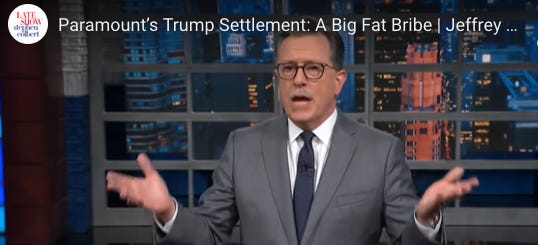
Stephen Colbert during his fateful “Big Fat Bribe” monologue on July 21st
Not everybody was laughing though. Two days later, Colbert again walked onto the stage at the historic Ed Sullivan theater, where his shows are recorded, and told his stunned audience that he’d just been notified that Paramount would be terminating the Late Show for purely “business reasons.”
The “Big Fat Bribe,” as Colbert described it, worked this way: The Paramount merger with Skydance Media (founded by David Ellison, whose billionaire father has a history of supporting Republican causes and candidates) would need the consent of the Federal Communications Commission (FCC). The FCC had to approve the merger and, of course, one way for Trump to exert his displeasure with 60 Minutes would be to use his influence on the FCC—with its majority of Republican commissioners—to block the lucrative merger. With Paramount’s $16 million commitment to Trump in hand, the FCC announced its approval of the merger on Thursday, the day after Colbert told his audience that his program was being cancelled.
The transaction could have been done with winks and denials to at least paper-over the blatant corruption. But Trump clearly doesn’t much care. After all, it was only a year ago that the conservative majority on the Supreme Court endowed him broad immunity for official acts, up to and including using the Justice Department or IRS to go after his political enemies. This was the “I alone can fix it” Trump who managed to convince his voters in 2016 that he would use his knowledge of a corrupt system on behalf of his MAGA supporters.
“I absolutely love that Colbert got fired,” Trump wrote on his social media platform on Friday. In addition to the $16 million to settle the fanciful $16 million lawsuit aimed at 60 Minutes, Trump has told reporters about the existence of a side deal whereby Skydance would fund at least an equal amount for advertising to promote conservative causes—though Skydance reportedly disputes this.
The aggressive reach of the deal is about much more than money though.
Under the agreement, Skydance pledges that, under Paramount’s “new management,” it will eliminate all “diversity, equity, and inclusion” (DEI) initiatives and that a new “ombudsman”—reporting directly to Paramount’s new president, will help ensure “CBS’ reporting is fair, accurate and fact-based.”
How Skydance executives actually engage with CBS News and 60 Minutes will be interesting to watch. But Trump-appointed FCC chairman Brandon Carr said this to a CNBC interviewer when pressed about what he and Trump expect.
“What’s happening here is I think President Trump is fundamentally reshaping the media landscape,” Carr said. “And the way he’s doing that is when he ran for election, he ran directly at these legacy broadcast media outlets, ABC, NBC, CBS. For years, government officials just allowed those entities with execs sitting in Hollywood and New York to dictate the political narrative.”
For some reason Carr didn’t mention that the “legacy media,” whatever their flaws, at least try to conform with journalism ethics that Fox News and most other conservative-advocacy networks regard as optional, at best. The notion that “both sides” are “fake news” may win nods and cheers over beers but it is generally not true. The elaborate discovery in the defamation case of Dominion Voting Systems v. Fox News Network proved that, which is why Fox settled the case by paying Dominion nearly $800 million. Not coincidentally, it was team Trump’s bogus accusations that voting machines had been rigged against Trump—false claims Fox amplified in its programming—that led to the lawsuit. Truth is a defense for defamation. Discovery in the Dominion case showed Fox hosts and executives knew the truth—they just didn’t want to broadcast it for fear of losing audience share to other right-wing media outlets.
It’s telling that FCC chairman Carr chooses the words “dictate the political narrative” to describe what’s at stake. It’s a giveaway to the underlying nature and purpose of Trump’s open thuggery—which is to harass and threaten publications and networks who dispute, let alone question, his relentlessly self-serving lies.
The one Democratic commissioner at the FCC, Biden-appointee Anna Gomez, issued a stinging rebuke to the commission and the corporate scions who engineered the deal. This after she cast the lone vote last week against the Paramount/Skydance merger. She referred to Paramount’s pay-off to Trump as a “cowardly capitulation” that undermined the First Amendment.
She then tore into the FCC for abetting and framing the transaction.
“The Paramount payout and this reckless approval have emboldened those who believe the government can—and should—abuse its power to extract financial and ideological concessions, demand favored treatment, and secure positive media coverage,” Gomez wrote. “It is a dark chapter in a long and growing record of abuse that threatens press freedom in this country. But such violations endure only when institutions choose capitulation over courage. It is time for companies, journalists, and citizens alike to stand up and speak out, because unchecked and unquestioned power has no rightful place in America.”
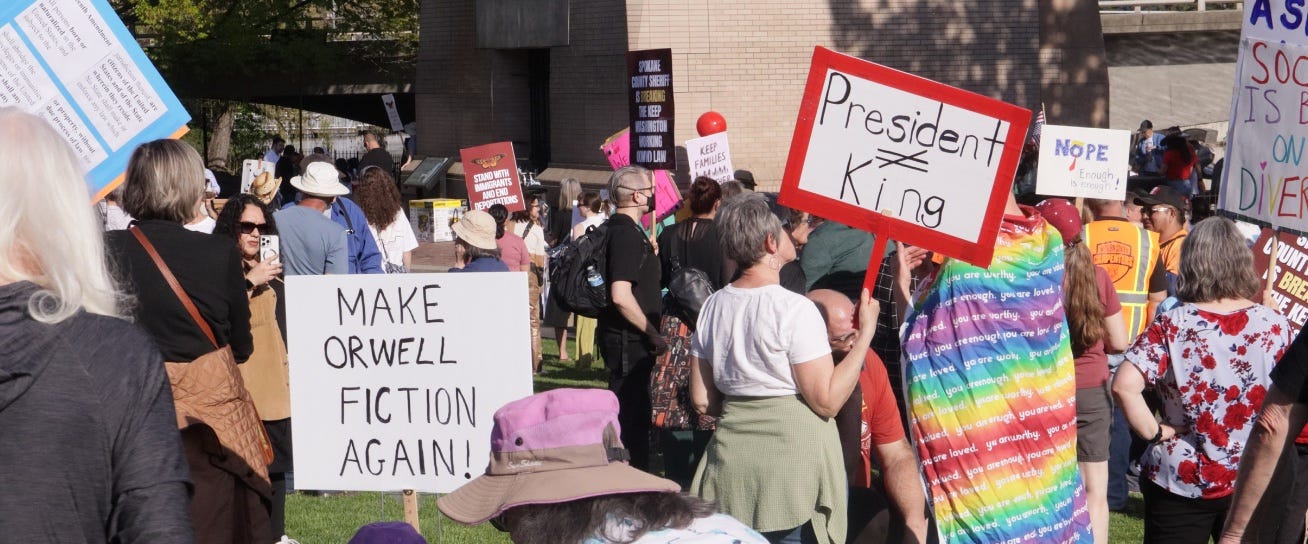
Anti-Trump protestors in Spokane’s Riverfront Park
By contrast, Chairman Carr was simply saying the quiet part out loud as he took a victory lap after the commission approved the merger Paramount earned by handing Trump millions of dollars to settle a bogus lawsuit. Carr’s public statements about how the FCC is now on board to help Trump wrestle control of the “political narrative” is stunning, or at least would be stunning at any other time in the commission’s ninety year history. It’s tantamount to Robert F. Kennedy, Jr.’s, gutting of the scientific expertise within the Department of Health and Human Services.
One could say it demonstrates a lack of awareness on Carr’s part about the role of a free press in a democracy. But, as with the whole lot of the Trump team (Carr was a co-author of the controversial Project 2025 blueprint for helping Trump consolidating power in the executive branch) the purpose is not to promote the public interest but to better serve Trump’s interests and those of his corporate backers, now including Paramount and Skydance.
I’ll just add, on a personal note, that I agree with Anna Gomez about what a “dark chapter” this represents for American journalism and freedom of the press. I’ve worked for brave publishers and with fiercely ethical journalists in my career but have also resigned positions, several times, over ethical breaches. The most successful model for independence in American journalism today is the Pro-Publica investigative journalism project, founded in 2008, whose recent reporting on the corruption of the U.S. Supreme Court has been invaluable. A winner of multiple Pulitzer Prizes, Pro-Publica relies on a philanthropic endowment and direct reader support. Of course, over time, even this model relies not only upon the vigilance of scrupulous editors but a counter-intuitive commitment of major funders to NOT try to influence coverage in ways that avoid scrutiny of their pet projects, or favor projects that benefit them either financially or socially.
Finally, and perhaps this goes without saying, the Substack platform you’re reading here, has been a godsend for independent writers and journalists (me included) who might otherwise not have the means or capacity to grow an audience based on direct paid subscriptions. I’m also regularly impressed by the number of talented young reporters who continue to emerge against all sorts of new trials for those choosing journalism as a career. Perhaps that’s a dim, hopeful light compared to the tragedy of 60 Minutes and, for that matter, the stunning decline of the once venerable Washington Post, now under Amazon founder Jeff Bezos’s control.
Today’s post is free for everybody, but please support this project with an annual, paid subscription to The Daily Rhubarb at the link above…
But it is a light. And we’re not giving up.
—tjc