

The distance between justice and repression
May 26, 2026

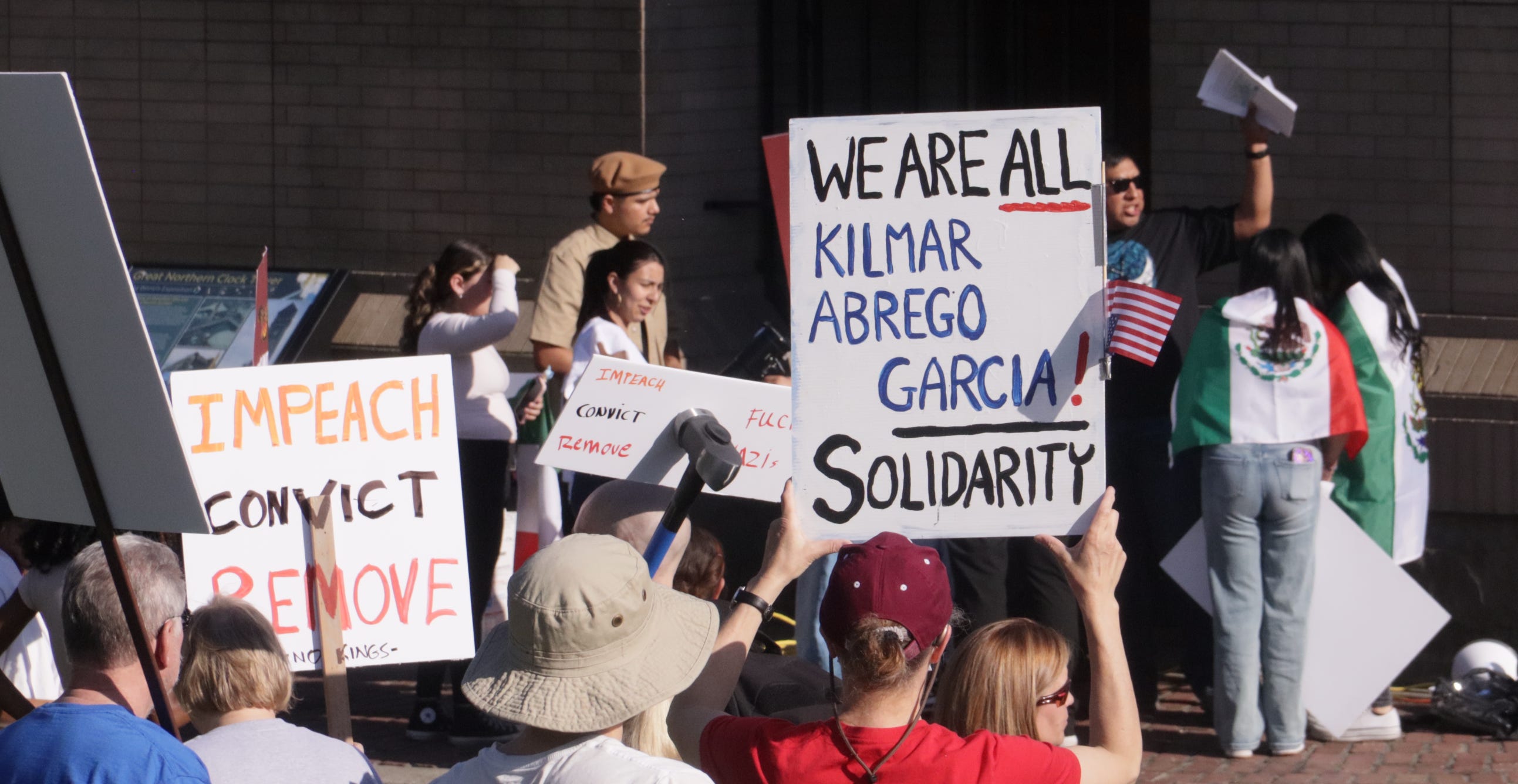
What the Abrego-Garcia case reveals about America, on Memorial Day
My connection to Memorial Day is spliced to my father’s service and his remembrance. It is the shared memory of his three uncles—his mother’s brothers—very young men from Scranton, PA who served in Europe during the war against the Nazis. I’ve written about them in this space before. But it bears repeating.
Of the three, the youngest died in a tank battle, another returned from Europe with enduring post-traumatic stress. All three passed before I could meet them, but their sacrifices were passed in voice and and letters to me and my siblings. My father spoke of them wistfully and he would fly the flag for them, on Memorial Day and other patriotic holidays. I’m proud to disclose there are dedicated anti-facists in my lineage

My father’s uncles
My father was also a big “C” Catholic who, in his last years, was deeply troubled by a scandal and a scoundrel. The scandal was the Catholic church’s coverup of sexual abuse by priests, bishops and cardinals. The scoundrel was Donald Trump who, in the last year of dad’s life, astounded him with his arrogance, venality and general disdain for civility.
I consider myself blessed to have had a father who deeply believed in America —not as a bustling venue for sports or entertainment or layers of business empires—but as a cultural melting pot and, on its better days, a beacon of freedom and justice. That’s why I think he would have cared quite a lot about Kilmar Abrego-Garcia and his family
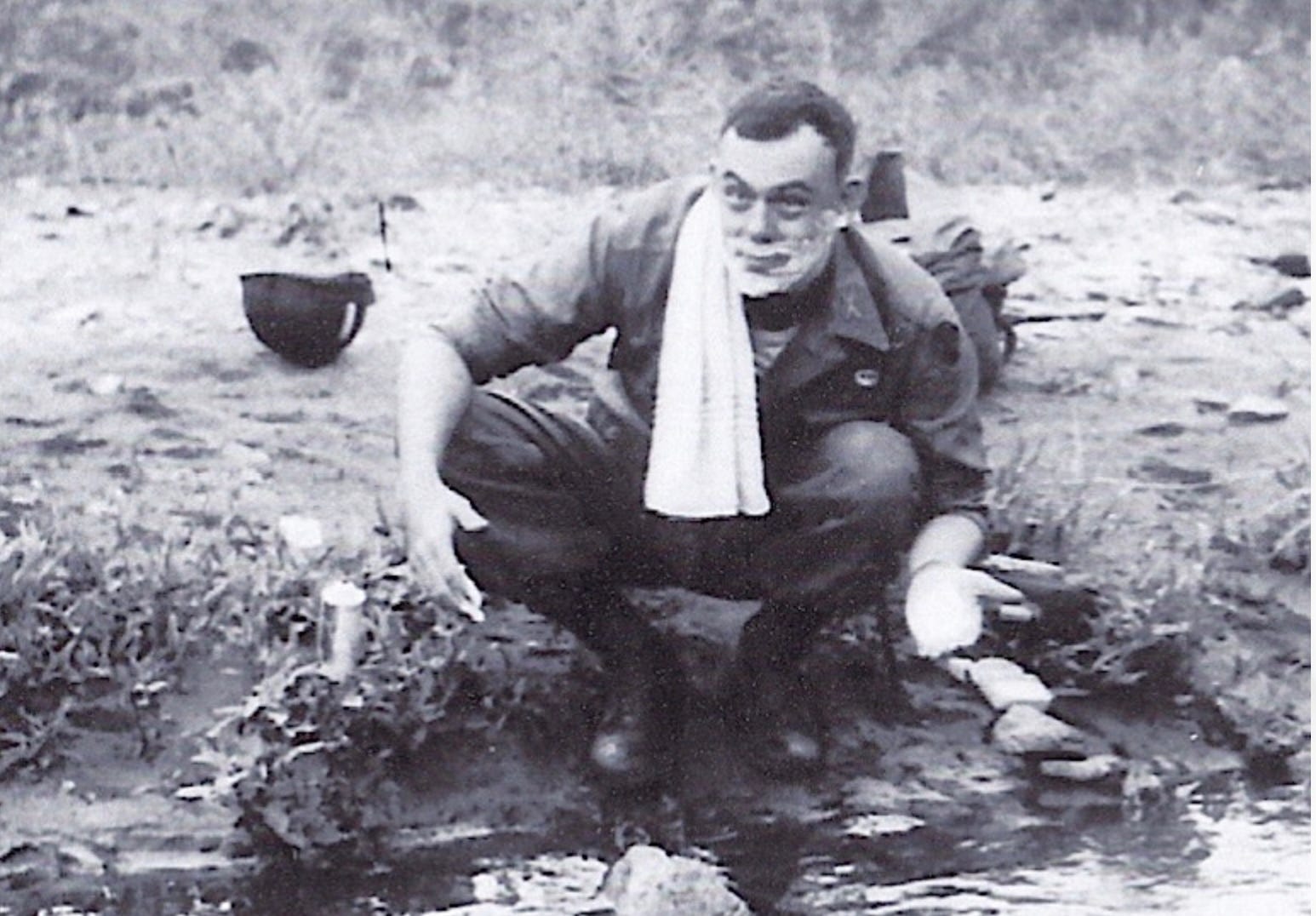
My father, Donald J. Connor (1932-2017) shaving streamside while on active duty in Korea in 1956, the year I was born.
Amidst the torrent of other noteworthy events leading into the Memorial Day weekend, Abrego-Garcia won a long-anticipated federal court victory against the Trump Justice Department last Thursday.
From his bench in Nashville, Tennessee Federal District Court Judge Waverly D. Crenshaw Jr., found the Trump Justice Department’s prosecution of Abrego-Garcia—which was underway in his courtroom—was motivated by vindictiveness. So he dismissed the case.
Although Abrego-Garcia’s saga has been well-covered in the media, it’s only when you unpack Judge Crenshaw’s 32-page opinion that you get to appreciate the depth and tenor of the malevolence involved.
The details matter. They illuminate the disdain Trump and his re-purposed Department of Justice have for the rule of law. For example, it was a career Justice Department immigration lawyer— Erez Ruvenni—who simply told the truth to a federal district court about the mistake the government made by sending Abrego-Garcia to El Salvador. Ruvenni was immediately suspended by then-Attorney General Pam Bondi for, as she put it: “failing to zealously advocate on behalf of the United States.”
In other words, the veteran lawyer was immediately sidelined for his ‘failure’ to lie to a federal judge. Ruvenni was subsequently fired. It was also conspicuous that on the very day Abrego-Garcia was charged, Ben Schrader—the lead prosecutor in the Middle Tennessee district where the indictment was filed— resigned his post rather than participate in the hastily contrived indictment.
Still, to Judge Crenshaw, the most persuasive voice was that of someone we’ve heard quite a bit from lately. His name is Todd Blanche. He is a former trial lawyer for Donald Trump who (unsuccessfully) defended the then-former president in the Stormy Daniels hush money case. That was the trial resulting in a jury finding Trump guilty of 34 felony counts of falsifying business records. Blanche is better known, now, as the Acting Attorney General of the United States of America, a promotion he assumed (after a year as Bondi’s top deputy) when Trump dismissed Bondi in mid-April.
As Judge Crenshaw points out, Blanche refused to make himself available to testify in the evidentiary hearing the judge scheduled to evaluate prosecutorial vindictiveness. But the judge did note that Blanche had made himself available for a Fox News interview last June. It was in that interview that Blanche let the proverbial cat out of the bag, telling Fox viewers that federal prosecutors under his command re-opened an investigation into a three-year-old closed case against Abrego-Garcia for allegedly transporting illegal immigrants.
As to what triggered the re-opening of the cold case, Blanche said it was because a “judge in Maryland’ had “questioned” the decision to put Abrego-Garcia in chains and—in violation of an immigration judge’s standing orders—deliver him to the notoriously brutal CECOT prison in El Salvador.
The judge Blanche referenced is Federal District Court Judge Paula Xinis. Judge Xinis’s courtroom is in Maryland, where Abrego-Garcia was living and working when he was taken into custody by a federal Homeland Security Agent in March of last year and—within 72 hours—delivered to CECOT.
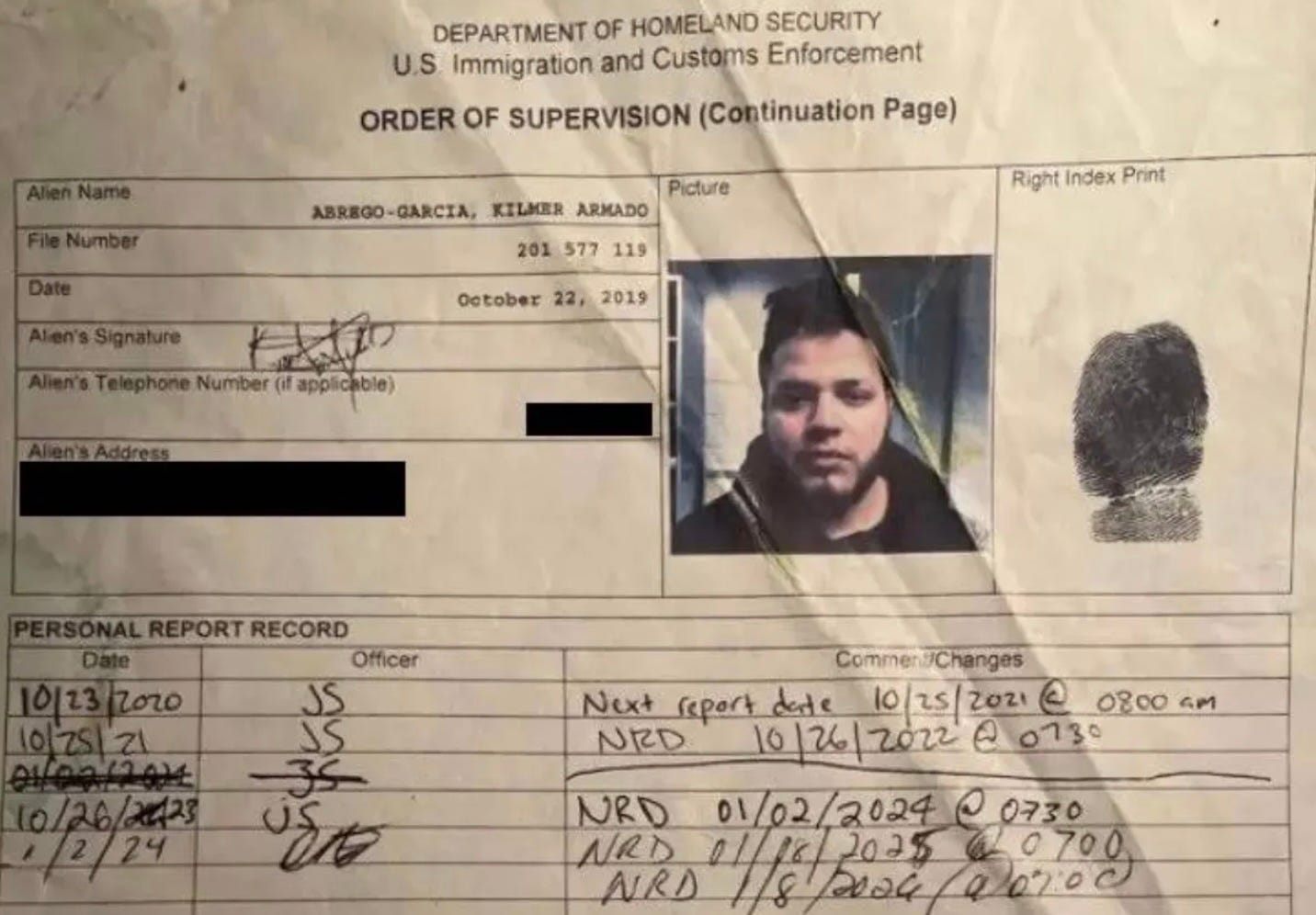
Image courtesy Wikimedia Commons
Before we get deeper into Judge Xinis’s saga, it’s important to register the context. Even before Judge Xinis “questioned” Abrego-Garcia’s sudden deportment to El Salvador, a well-respected federal district court judge in Washington D.C.—James Boasberg—had initiated his own inquiry. Based on their evasiveness, he strongly suspected Justice Department officials had purposefully violated his order to stop the airplanes flying Abrego-Garcia and 259 other deportees to CECOT.
Judge Boasberg’s objection was that more than half the deportees had been denied due process prior to being put on the planes to El Salvador. In April of last year, he found “probable cause” to hold Trump Administration officials in criminal contempt for “willful disregard” of his orders to turn the planes around.
Judge Xinis came into the picture because pro bono lawyers for Abrego-Garcia petitioned her court to compel his return from El Salvador. And it was in her court where she not only determined Abrego-Garcia was wrongly deported, but demanded the government “effectuate” his return him within 72 hours.
The White House, through press secretary Karoline Leavitt, quickly derided Judge Xinis and said it would not comply with her order. As an added distraction, Leavitt insisted Abrego-Garcia was a member of a violent Salvadoran street gang, MS-13, though—as Judge Xinis noted—the Justice Department had provided zero evidence of the MS-13 accusation.
“This [the forced deportation of Abrego-Garcia to El Salvador] was an illegal act,” Judge Xinis told a Justice Department lawyer in open court, “Congress said you can’t do it, and you did it anyway.”
Team Trump then filed an emergency appeal with the U.S. Supreme Court. At first glance, the high court seemed to side with Judge Xinis even as it tried to appease Trump by instructing her to amend the ruling by removing the word “effectuate” but leaving the word “facilitate.” This she did. But rather than clarifying matters, the court-ordered change created instant confusion as to whether the Supreme Court was telling, or simply asking, the President to retrieve Abrego-Garcia from CECOT.
Attorney General Pam Bondi seized the latter interpretation, announcing: “He (Abrego-Garcia) is not coming back to our country. [El Salvadoran] President Bukele said he was not sending him back. That’s the end of the story,” she told reporters.
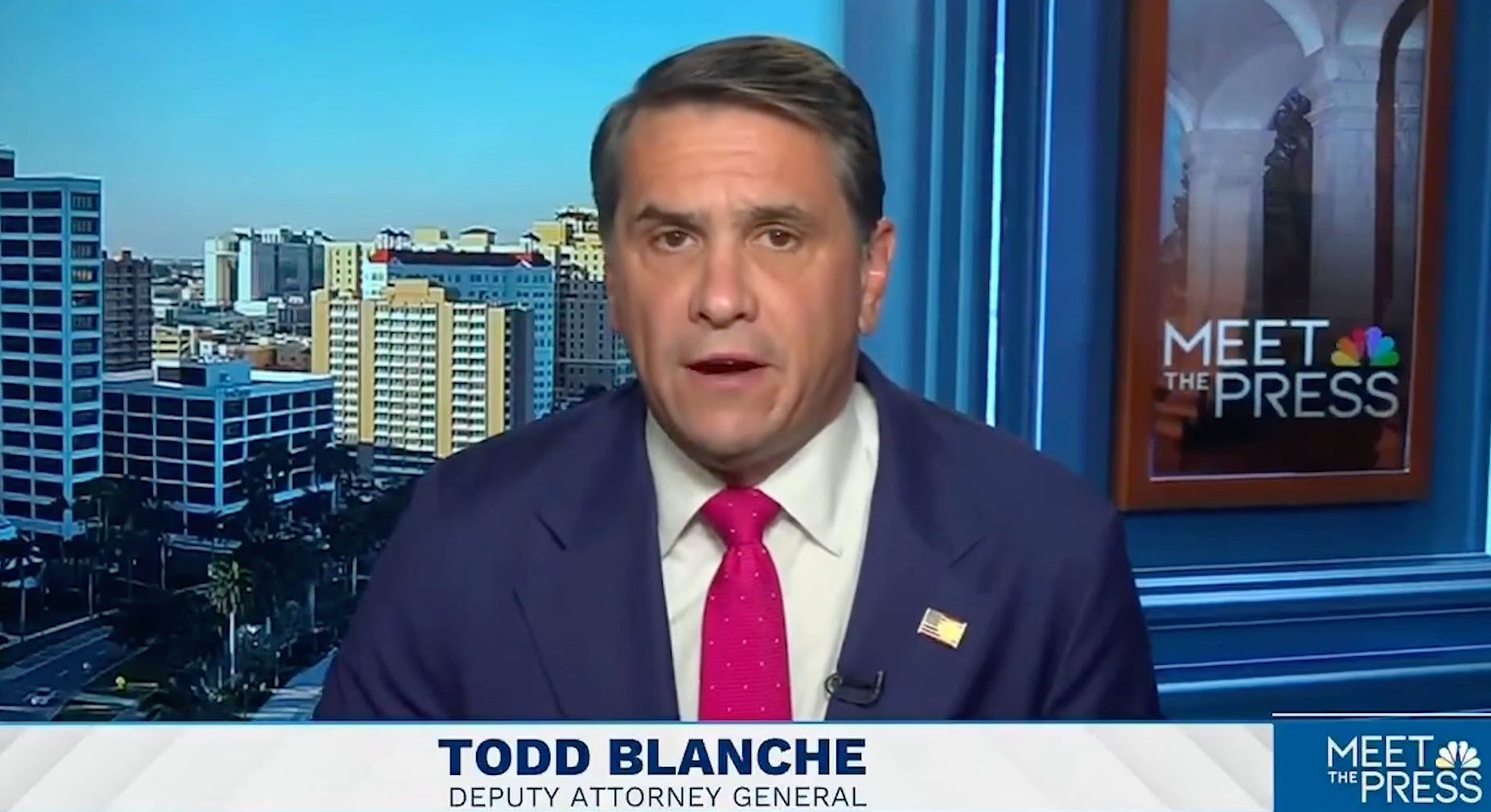
Acting Attorney General, and former Trump lawyer, Todd Blanche appearing on NBC’s Meet the Press late last year.
But it wasn’t the end of the story.
As the legal world braced for a Constitutional crisis, Team Trump came up with a better idea. They would “facilitate” Abrego-Garcia’s return from CECOT but immediately charge him with transporting illegal workers (based on the 2022 traffic stop in Tennessee) and take him into custody.
Much of Judge Crenshaw’s 32-page ruling is devoted to the clear evidence of how the Justice Department, under Bondi and then Blanche’s leadership, was trying to evade and stonewall the judge’s fact-finding efforts. But the clincher was Blanche’s statement on Fox News that the indictment of Abrego-Garcia upon his return from El Salvador was motivated by “a judge in Maryland”—obviously Judge Xinis—“who questioned that decision”—meaning the decision to send Abrego-Garcia to El Salvador.
But, as Judge Crenshaw recognized, Judge Xinis only became involved because Abrego-Garcia’s lawyers—in the exercise of defending their client’s civil rights against the mistaken and unlawful deportation to El Salvador—filed their complaint with her court.
The construction may seem a bit obtuse. But it boils down to Blanche publicly disclosing—on Fox—that the prosecution was directly related to Abrego-Garcia’s resistance to being sent off to the CECOT hell hole. He was only charged with the alleged trafficking offense because he resisted what the government’s own lawyers admitted was an egregious mistake—a mistake that literally put Abrego-Garcia’s life at risk.
How Donald Trump made Terry Moran Famous
To continue reading this post, and open up all the Daily Rhubarb fare, please become a paid annual subscriber at the link below. tx, tjc



Excellent reporting on Abrego-Garcia, TY