Right before our eyes
June 26, 2026


Justice Alito, the solid six, and a deep state of lies
It says something good about America, and something good about the people of Ohio, that hundreds of ordinary people showed up Thursday evening outside the Springfield City Hall. They came both to protest a Supreme Court decision delivered yesterday (Mullin v. Doe) and to express their support for the city’s Haitian community. It is not the first time they’ve done so.
They had also done so in the waning months of 2024 after JD Vance—the man who would become vice president in the second Trump term—let slip that the fable of Haitian immigrants in Springfield eating their neighbors pets was necessary in order to focus media attention on the problem with immigrants. He was clearly irritated that CNN’s Dana Bash had pressed him into a corner by challenging the veracity of his claim. Under that stress, he blurted the truth.
“If I have to create stories so the American media actually pay attention to the suffering of the American people, then that’s what I’m going to do.”
It’s important to note there was no “suffering” to speak of in Springfield, except among the Haitians who’d been collectively slandered. The lie of Haitians in Springfield devouring their neighbors’ pets was so vile that even the Republican governor of Ohio, Mike Dewine, wrote a New York Times guest column to denounce it.
DeWine is a Springfield native and his defense of the Haitian immigrants also underscored how important they’ve been to the resurgence of Springfield’s solvency after a period of “serious economic decline.”
“Some of that [the resurgence] is thanks to the dramatic influx of Haitian migrants who have arrived in the city over the past three years to fill jobs,” he wrote. “They are there legally. They are there to work.”
But it just didn’t matter. Vance and Trump kept repeating the baseless accusations, Trump famously so in his debate with then vice-president Kamala Harris on September 10th.
He did so with a raised voice, to display his anger and disgust, as if Trump himself was a pet owner whose cat had been consumed.
The case arose because the Trump Administration has been trying to revoke what is known as “Temporary Protective Status” (TPS) for refugees from Haiti and Syria.
The legal analysis of the case is tedious. Suffice to say the decision ultimately hinged on whether the Trump Administration, through the Department of Homeland Security, had abused its authority to end TPS for the refugees and, conversely, whether lower courts had overstepped their authority in questioning the DHS decision to do so.
One pivotal argument in the case (which sets the stage for the forced deportation of thousands of Haitian and Syrian refugees) is whether racial animus within the Trump administration drove the deportation decision. (According to an Ohio CBS News affiliate, the decision could affect 12,000 Haitians in central Ohio alone.)
Yesterday, as the Supreme Court announced its ruling, the racial animus question surfaced in the opposing decisions between Justice Samuel Alito, who authored the decision for the court majority, and Justice Elena Kagan, who authored the dissent.
Alito’s argument was that any allegation of racial animus in the Trump Administration’s suspension of TPS could be discounted or simply discarded given “the present administration’s general stance on immigration and its obvious antipathy toward past administration’s TPS policies.”
That was a bit much for Justice Kagan and her fellow dissenters. This from her dissent:
“Even putting the clear-error standard aside, the Haiti plaintiffs have carried their burden. The evidence they have offered includes statements by the President so repellent and racially inflected that the majority declines to put them in print. (Indeed, one measure of the President’s way of speaking about Haitians is to compare it with the majority’s, which is unfailingly respectful. So here are some of those statements.
Haitians are “eating the dogs . . . . They’re eating the cats. They’re eating—they’re eating the pets of the people that live [in Springfield, Ohio].” And: Haitians are also eating “other things too that they’re not supposed to be.” And: Haitians in the United States “probably have AIDS.” And: Haiti is a “shithole country,” which is “filthy, dirty, [and] disgusting.” And: Haitian immigration is“like a death wish for our country.” And: Haitians, along with some others, are “poisoning the blood” of our country. And: “Why is it we only take people from shithole countries” like “Haiti [and] Somalia”? “Why cannot we have some people from Norway [and] Sweden?”
The majority briefly replies that those remarks are not “overtly racial,” but it is hard to know what that means. Haitians are Black. (Norwegians and Swedes not so much.) The references—of filth, disease, and primitiveness—are shot through with racial stereotypes and tropes. It is hard to imagine the statements being made today of any White community.”
Indeed, the only ostensibly oppressed or distressed immigrants the Trump Administration has welcomed into the United States are white South Africans. This from Tuesday’s New York Times:
In the coming weeks, the United States plans to provide a welcome gift to white South Africans entering the United States as refugees.
They will get an Android tablet, an American flag and copies of the Constitution and Declaration of Independence. They will also receive a packet of literature that provides a sanitized, Trump approved view of American and South African history, one that criticizes racial equity and civil rights laws and promotes claims of discrimination against white people.
There was a moment I caught this morning that helps capture just how brazen the Trump-world is in its mission to own the libs. It came from senior MS NOW legal analyst Lisa Rubin who shared her reaction to a social media post sent out, yesterday, by Katy Miller, a podcaster and the wife of top White House domestic advisor Stephen Miller. Her post—in clear reference to the Supreme Court’s decision—declared that it was ‘a great day for the dogs and cats of Springfield.’
“When I read that at my desk,” Rubin said on air, “I literally gasped so loudly that half the reporters in (the) news room looked around to see what I was reacting to.”
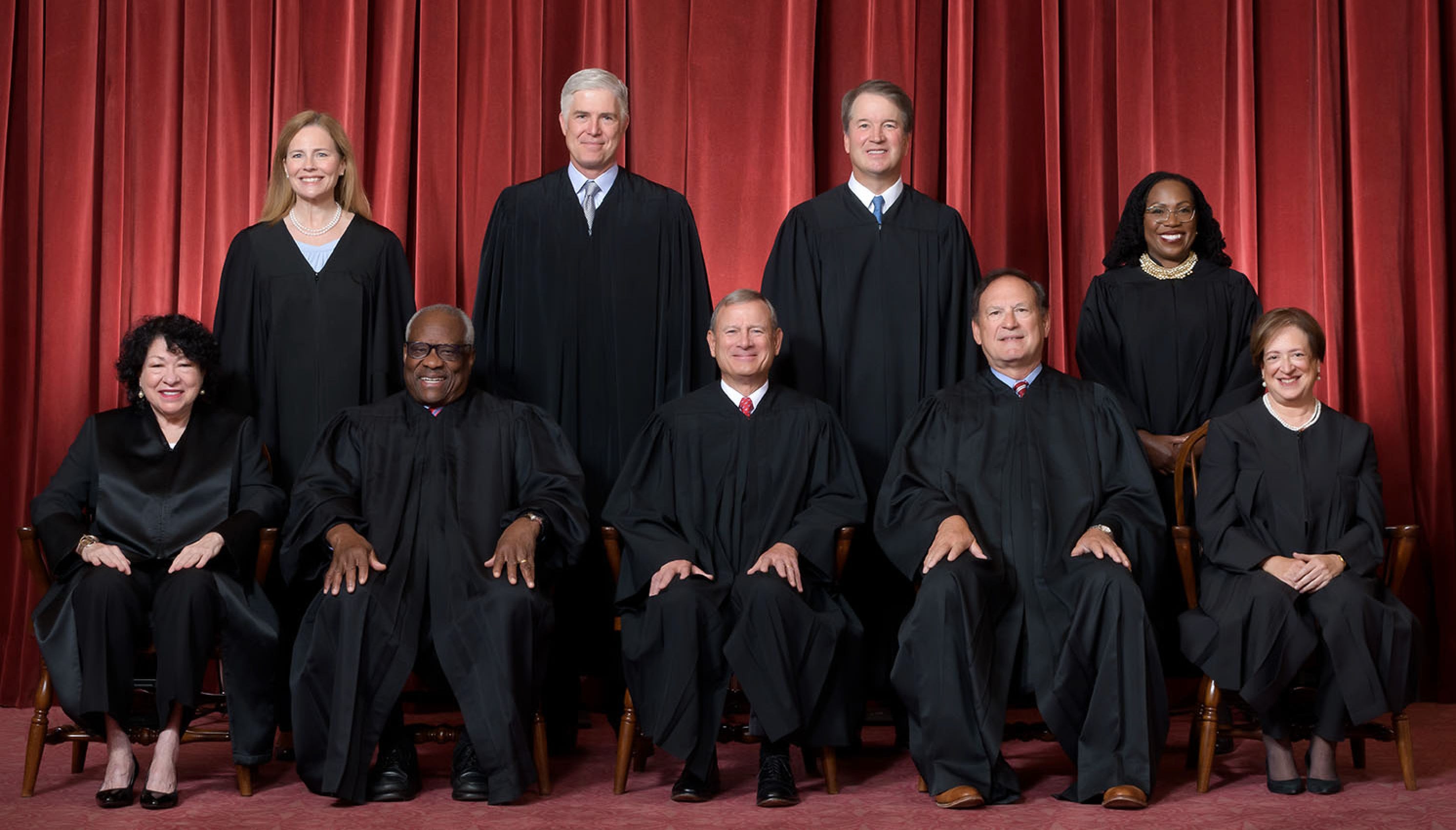
The Roberts’ Court in a 2022 official photograph, Justice Samuel Alito and his nemesis in the Mullin v. Doe case Justice Elena Kagan are in the lower right corner of the photograph
Today’s post is free to Rhubarb Salon readers, but please support The Daily Rhubarb with a paid annual subscription at the link below…
There is something surreal about the Roberts Court’s devotion to the Trump regime inasmuch as it defies all evidence of Trump’s disdain for the essence of the Constitution and its structural balances of power. The decades-long plan, driven by the Federalist Society (in which all six of the justices who joined the decision in Mullin v. Doe have been members) was to repeal Roe v. Wade and advance the “unitary executive” theory of presidential power.
It’s frightening to imagine what the Roberts Court would have done had it been in place during Watergate. Would the Roberts Court have done what the Burger Court did in unanimously ordering Nixon to turn over the famous tape recordings that led to his resignation?
I doubt it.
The fealty of the Roberts Court looms like a summer storm cloud as the next nationwide election (and the possibilities for election interference) is less than five months away.
Meanwhile, back in Springfield, a more immediate reality unfolds.
“I think Springfield will be left in shambles because the Haitian families that I work with, they want to work,” a county employee named Ellie Millender told a local television reporter. “They’re working jobs that Americans don’t want to work. These are people that we spend time with every day, that go to our churches, that play with my children in the park. It’s so deeply, deeply disheartening,”
—tjc