On bigotry (Part 2)
June 1, 2026

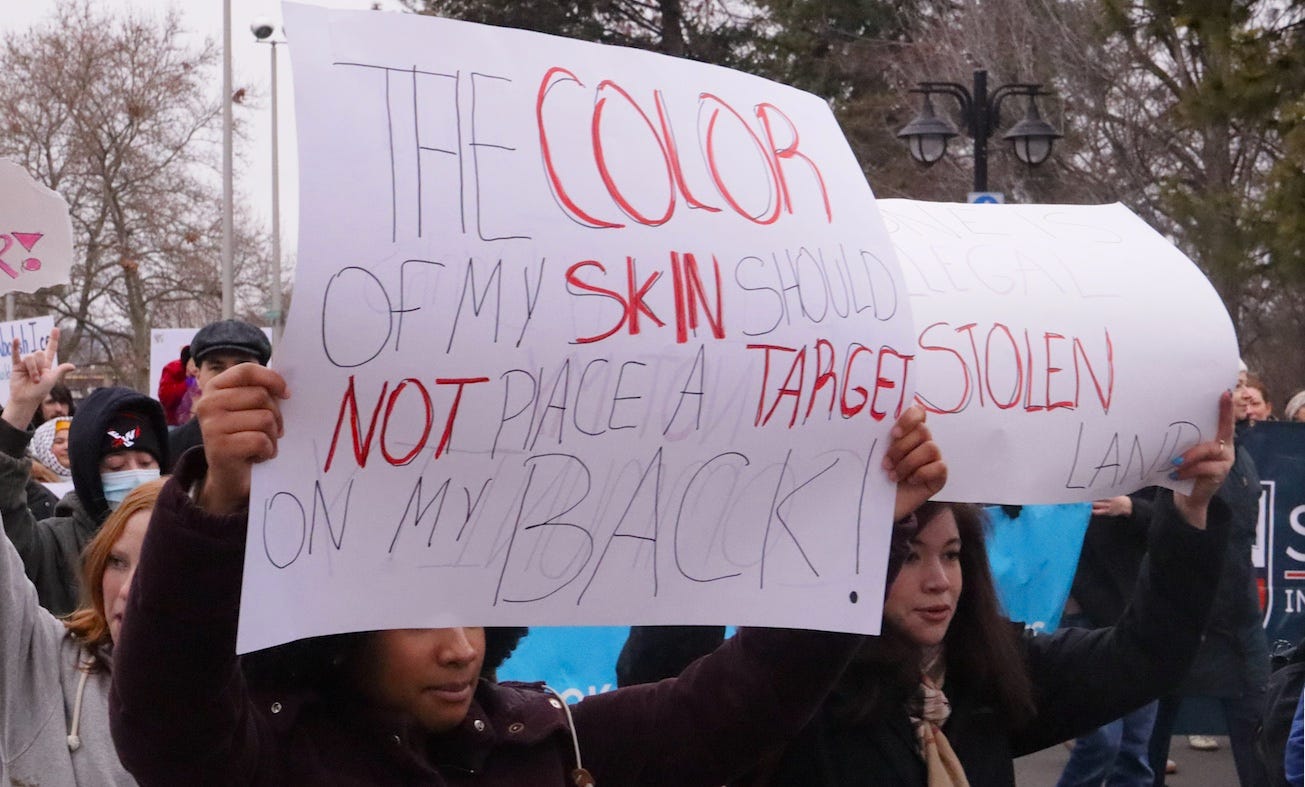
The living scars of racism, and the banality of evil
“A lot of us in the party liked to believe the dark side was a recessive gene, but it’s a dominant theme. And it’s all about race.” Former Republican political strategist Stuart Stevens in a 2020 interview with Mother Jones’s David Corn.
To better understand bigotry, it may help to spend time with bigots and hear them out. That’s a challenge for me. I tend to get triggered, and react with angled remarks and sarcasm. It can go downhill from there, with nothing much accomplished other than salting the grudges.
I’ve learned more via circumstances. In 1941, my father’s family moved from New York to the town of Gamboa, in what used to be the Panama Canal Zone but which is now part of the Republic of Panama. Gamboa was an apartheid town, although we didn’t call it that. The official nomenclature, from the early 1900s, was “gold” and “silver communities.” “Gold” for the mostly white Americans. “Silver” for the black West Indians.
The street behind the Catholic church we attended was the dividing line between Gamboa—with its overwhelmingly white, Panama Canal Company Americans—and Santa Cruz which is where the West Indians (who provided the muscle part of the labor for canal operations, including the work on my grandfather’s drill boat) lived and raised their families. Suffice to say the housing and the amenities for we the people in Gamboa were superior to those afforded the West Indian workers and their families in Santa Cruz. The pool I learned to swim in was s stone’s throw from Santa Cruz. The pool was eventually integrated in the late 1960’s but by that time our family had moved to another company town closer to Panama City.
The first African-Americans I got to know were boys and young men I met on football fields over a stretch of ten years, beginning in fourth grade. They were the sons from military families who lived on the forts and bases that were part of the U.S. Southern Command.
A beneficent side-effect of athletics is how sport—team sports especially—confront racist attitudes, not as part of a workshop or seminar but as part of the sweat and trials of team-building. You’re either a good teammate or you’re not and it’s a communal exercise that, for better or worse, is inherently revealing. To be sure, football can discourage people who’d rather not be blocked and tackled. But it can also open hearts and minds and change people for the better. We trained and played in the tropical heat and the ankle deep-mud because, in Panama, football season arrives with the rain. Some days were miserable and, in one instance, sadly fatal. But the collaboration and respect it fostered—as a corollary to team-building—is powerful stuff.
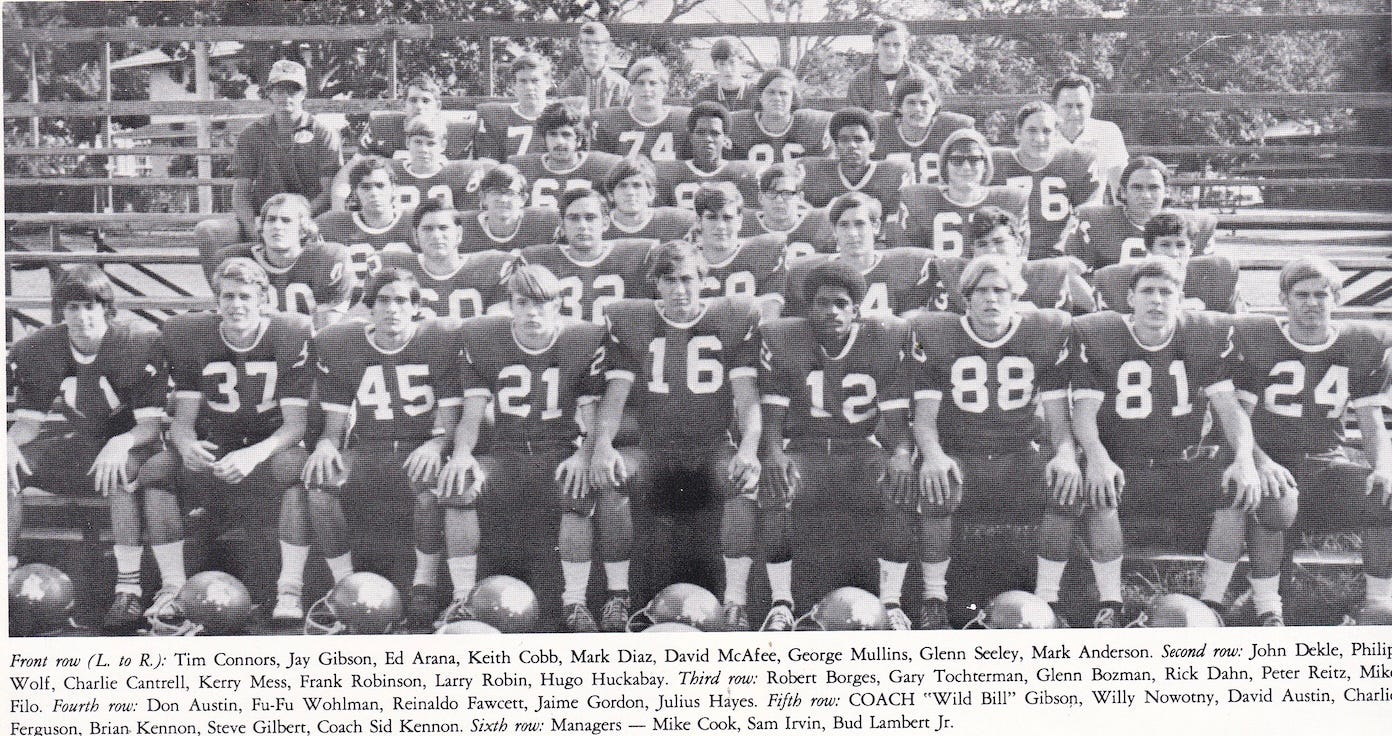
The Balboa High “Bulldogs” in our undefeated season of 1972, that’s me in the front row, far left
One of the abominations that we Americans will have to reckon with, for years to come, is the firing of Charles Q. (CQ) Brown, Jr., the second African-American to serve as the nation’s top military officer. He was summarily dismissed by Donald Trump on a Friday night in February of last year, less than a month after Trump chose Pete Hegseth to be the nation’s Secretary of Defense.
Hegseth had made his position on CQ Brown known months in advance. In November of 2024 (before his appointment by Trump) Hegseth told a former Navy SEAL turned podcaster that Brown was pushing a “woke” agenda for the Armed Services and that he should promptly be fired.
Brown’s subsequent dismissal coincided with the firing of the military’s two top women: Coast Guard Commandant Linda Fagan, and Chief of Naval Operations Lisa Franchetti. Franchetti, like Brown, was a member of the Joint Chiefs. Like Fagan and Brown, she was replaced by a white male.
That this happened late on a Friday is no coincidence. Weekends are days off for most journalists and, consequently, events that are deeply transformative tend to get reported as spot news, as though they are warehouse fires or aviation accidents. But this was no accident. It was a purposeful, racist rebuke not just to the integration of the military’s leadership but to the ostensibly merit-based culture of the nation’s armed forces.
In contrast, it was raw, power politics that got Pete Hegseth over the line, to call himself the “Secretary of War,” and behave as though “rules of engagement” to prevent war crimes were for sissies. As Jane Mayer’s diligently fact-checked reporting for The New Yorker revealed in late 2024, Hegseth was well-known as a womanizer with a drinking problem. His leadership of two, non-profit advocacy groups— working on behalf of military veterans—was plagued with financial mismanagement. Fealty to Trump is a trademark of the current, Republican-controlled Congress. Even so, the vote to nominate Hegseth to lead the military was deadlocked in the Senate and required the tie-breaking vote of Vice President J.D. Vance to secure Hegseth’s appointment.
It does beg a question: What kind of country would hire a Pete Hegseth to lead its military, and fire a CQ Brown Jr.?
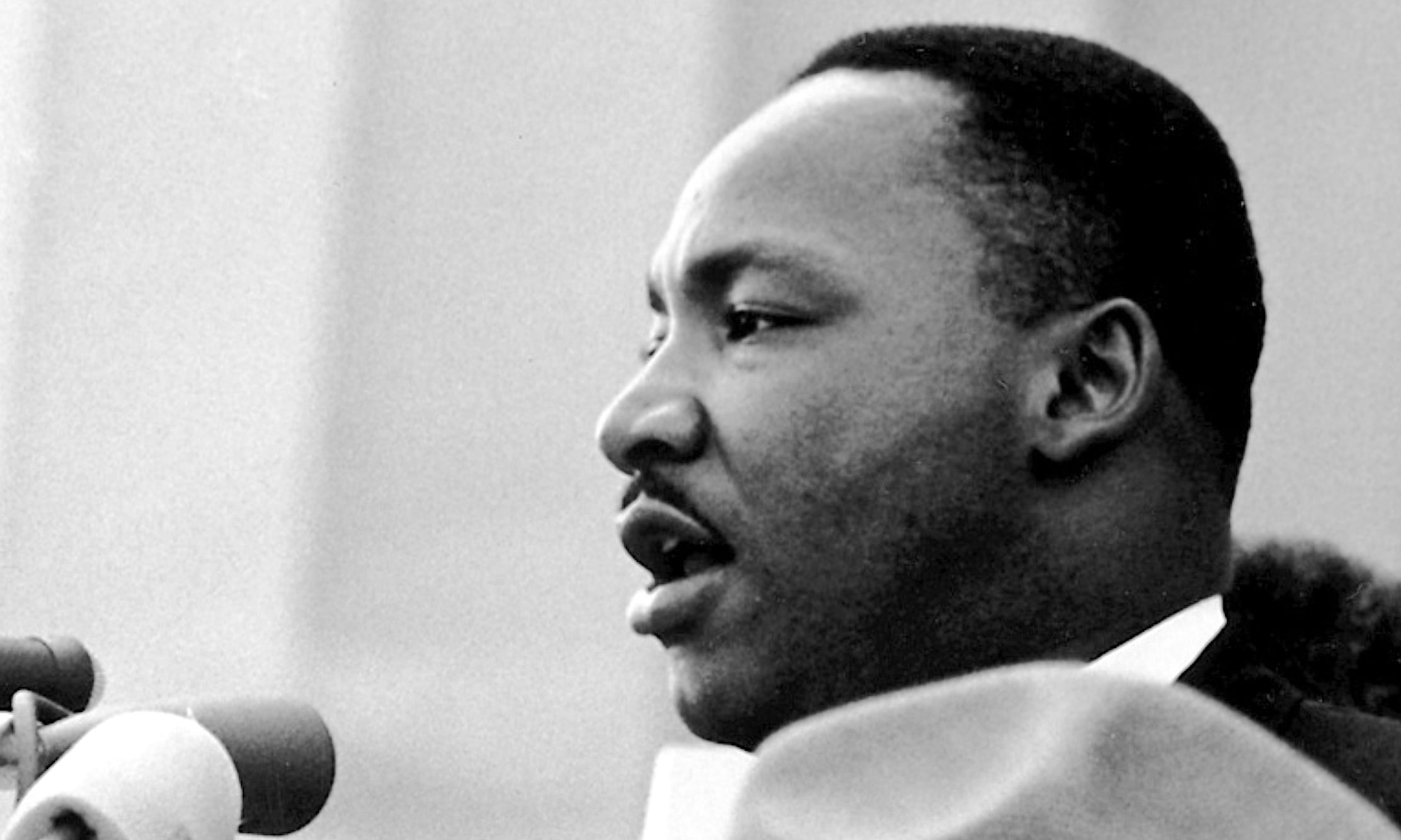
Martin Luther King, Jr., delivering his “I have a Dream” speech during the march on Washington in the summer of 1963
Some context.
CQ Brown was a year old when Martin Luther King, Jr., gave his famous “I have a Dream” speech on the steps of the Lincoln Memorial in August of 1963.
This is part of what King said that day:
We can never be satisfied as long as our children are stripped of their selfhood and robbed of their dignity by signs stating: for whites only.
We cannot be satisfied as long as a Negro in Mississippi cannot vote and a Negro in New York believes he has nothing for which to vote.
No, no, we are not satisfied, and we will not be satisfied until justice rolls down like waters, and righteousness like a mighty stream.
The next year, President Lyndon Baines Johnson signed the Civil Rights Act of 1964. It was followed, in 1965, by the federal Voting Rights Act, barring race-based voter discrimination that had become rampant in the states of the former confederacy. A pivotal change was to compel states with a history of brazen discrimination against African Americans to “pre-authorize” voting changes to the federal Justice department, or a panel of federal judges, in advance of implementing them.
The law worked, and received strong bipartisan support until the Supreme Court intervened. In a 2013 decision-authored by Chief Justice John Roberts (Shelby County v. Holder) the five Republican-appointed justices outvoted the four Democratic-appointed justices to negate the sections of the Voting Rights Act requiring pre-authorization.
In his majority opinion, Justice Roberts wrote, “the conditions that originally justified these measures no longer characterize voting in the covered jurisdictions.”
In other words, Roberts was declaring that racism in the states of the former confederacy had been so diluted that it was no longer an impediment to civil rights. Thus the “pre-clearance” requirement was deemed unconstitutional. In her dissent for the court minority, Justice Ruth Bader Ginsburg wrote that “(t)hrowing out pre-clearance…is like throwing away your umbrella in a rainstorm because you are not getting wet.”
As legal scholar Lisa Graves writes in her 2025 book, Without Precedent, measures to suppress voting access by African Americans in the states no longer bound by the “pre-clearance” requirement “started going into effect immediately, within minutes” of the court’s announced decision.
There is a straight line between the green light the Roberts’ court signaled to Republican-controlled state legislatures in Shelby County v. Holder 13 years ago to the Roberts’ courts continued winnowing of voting and civil rights protections for African Americans. Most recently, with its 6-3 ruling (again with Republican-appointed judges voting as a bloc against the Democratic appointees) in Louisiana v. Calais a month ago, the Supreme Court continued to empower southern, white voters (who tend to vote Republican) at the expense of African American representation in state legislatures and the U.S. House of Representatives.
As Graves points out, the chief justice would like Americans to believe that “things have changed in the South” after the election of the nation’s first black president in 2008. But that’s obviously not the case as the Calais decision only encouraged Trump to press his demands on southern state legislators to redraw Congressional districts to favor white, Republican candidates at the expense of African-Americans who typically align with Democrats.
This isn’t just a southern state problem. It’s a nation-wide push to rescind our supposed commitment to human rights and basic decency. In its origin, to be “woke” is to be alert to the dangers and injustices of racism. And, yet, in the semantic sorcery of politicians like Trump and Florida Governor Ron DeSantis “woke” is a pejorative—a word flipped on its head to convey a threat to the hegemony of white power and privilege.
This isn’t conjecture. We hear it directly in voices like Trump’s and Hegseth’s. This is part of what Hegseth told to an audience packed with admirals and generals after he summoned them to a large auditorium in Quantico, Virginia eight months ago:
“This administration has done a great deal from day one to remove the social justice, politically correct, and toxic ideological garbage that had infected our department, to rip out the politics. No more identity months, DEI offices, dudes in dresses. No more climate change worship. No more division, distraction or gender delusions. No more debris. As I’ve said before and will say again, we are done with that shit. I’ve made it my mission to uproot the obvious distractions that made us less capable and less lethal.”
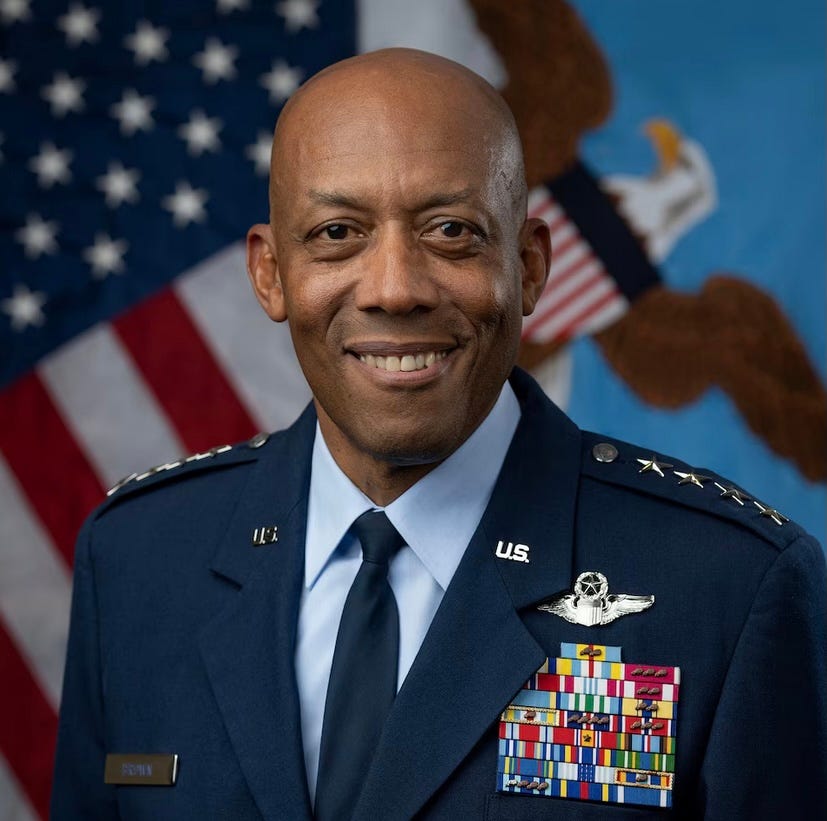
Former Chairman of the Joint Chiefs, CQ Brown, Jr., (U.S. Air Force photo)
And that brings me back to CQ Brown, Jr. who, in the light of day, was removed from his post simply because he is an African-American who spoke honestly about his career and the struggles men and women of color face in our society.
Three days after Brown’s dismissal the New York Times published an essay by former Secretary of the Air Force Frank Kendall. Kendall wrote this: I worked closely with Gen. Charles Q. Brown Jr. for two years when he was chief of staff of the Air Force, and for more than a year when he was chairman of the Joint Chiefs of Staff. In my entire 55 years of working in national security in many capacities, I have never known a steadier, wiser and more professional, patriotic or honorable officer than C.Q. Brown.”
From outside the military, the renowned author and long-time New Yorker contributor Malcolm Gladwell was recently asked a broad question about the human condition and the arc of the moral universe.
“Well,” Gladwell said, “it’s a little grim at the moment.” When pressed for a glimmer of hope, Gladwell talked about what he thinks will be a coming “moral backlash.” He illustrated his point by citing C.Q. Brown, whom he got to know when he was researching a 2021 book about the history of Air Force bombing tactics.
Please support this project with a paid annual subscription to The Daily Rhubarb at the link below…tjc
He did so by describing the ardor of the competition through which Brown was ultimately chosen to the head of the Air Force.
“To be Chief of Staff of the Air Force is to be the winner in one of the most grueling meritocracies we have in America,” Gladwell said. He described CQ Brown as an American “superstar.”
Gladwell is a sought-after public speaker. He said he recently shared Brown’s story with an audience he sensed was majority Republicans, most of whom would have voted for Trump. And Gladwell says they, too, were overwhelmingly disgusted by Brown’s dismissal, because, “this is not who we are, right?”
The dilemma is: it is who we are—now.
The problem—also embedded in CQ Brown’s firing—is that the open resurgence of bigotry presents a stark question for other talented, devoted non-white, non-male, non-straight Americans interested in a military career. If CQ Brown can be fired based on the color of his skin, then who is safe from racist or sexist retribution at the pinnacle of their careers? Who can really trust Americans to finally, and permanently, live up to our constitutional promises to level the playing fields for all?
Whatever the answer is to those questions, they’re not deliverable over night. Many of us, if not most, are in a state of shock at the ways in which open, resurgent bigotry from the highest branches of our government and courts have wiped away decades of imperfect progress toward a just, multi-cultural and multi-racial society. I only hope that my children, and CQ Brown’s children, live long enough to see changes they can begin to trust.
—tjc