Navigate this...
May 11, 2026

Spokane in the PFAS bear trap
Two weeks ago, when I last reported on a long-overdue rapprochement between Spokane government and its constituents on the West Plains, a thorny truth had elbowed its way into the light. Spokane’s governing class—including a plurality of its elected officials—is still behaving as though protecting the profitability of the Spokane airport and its orbit of real estate holdings take precedence over the welfare of the people they ostensibly represent.
For someone who’s raised children here, and enjoys the city’s welcoming culture, that’s a tough thing to have to write. From my experience as a public affairs journalist a couple analogies stand out, as they were both incredibly costly, powerfully alienating to citizens, and ultimately related to one another.
The first was in Ellensburg, in 1980 where my tenure as a city hall reporter overlapped with the city leaders’ panic when they realized their unwise involvement in the Washington Public Power Supply System’s (WPPSS) nuclear power project had entrapped them in a fiscal death spiral. It was a statewide debacle, one that devolved into what, at the time, was the largest municipal bond default in U.S. history. As the financial collapse hit home, Ellensburg’s ratepayers literally rioted—hammering the windows of the civic chamber as their city council wrestled with the bitter consequences. Not a good look. Though, in the end, the city named a bucolic park along the Yakima River after a venerable councilwoman, Irene Rinehart, who’d opposed the city’s involvement in the WPPSS power play but also lamented the anger that led to the rioting.
A consequence of the WPPSS collapse were pivotal changes to the state’s public financing laws. On one hand, the reforms made it harder to sue public entities for securities fraud, forcing litigants to prove what the lawyers call “scienter”—actual knowledge of falsity in securities disclosures. Yet, the legislature also opened the gates to higher damages for litigants who could prove knowledge of falsity.
Those changes in state law bit Spokane hard in the settlement of the River Park Square fiasco. The Wall Street investment firms who’d bought bonds to finance the public-private partnership with the Cowles family real estate companies had the evidence—including documents I’d obtained in my investigation for the on-line Camas Magazine. One of the memos clearly revealed that key city council members knew—as IRS investigators succinctly put it in a June 2004 report—“the casino was rigged.” The internal peer pressure to deliver the hidden subsidies that the Cowles’ family real estate companies sought could bend re-bar.
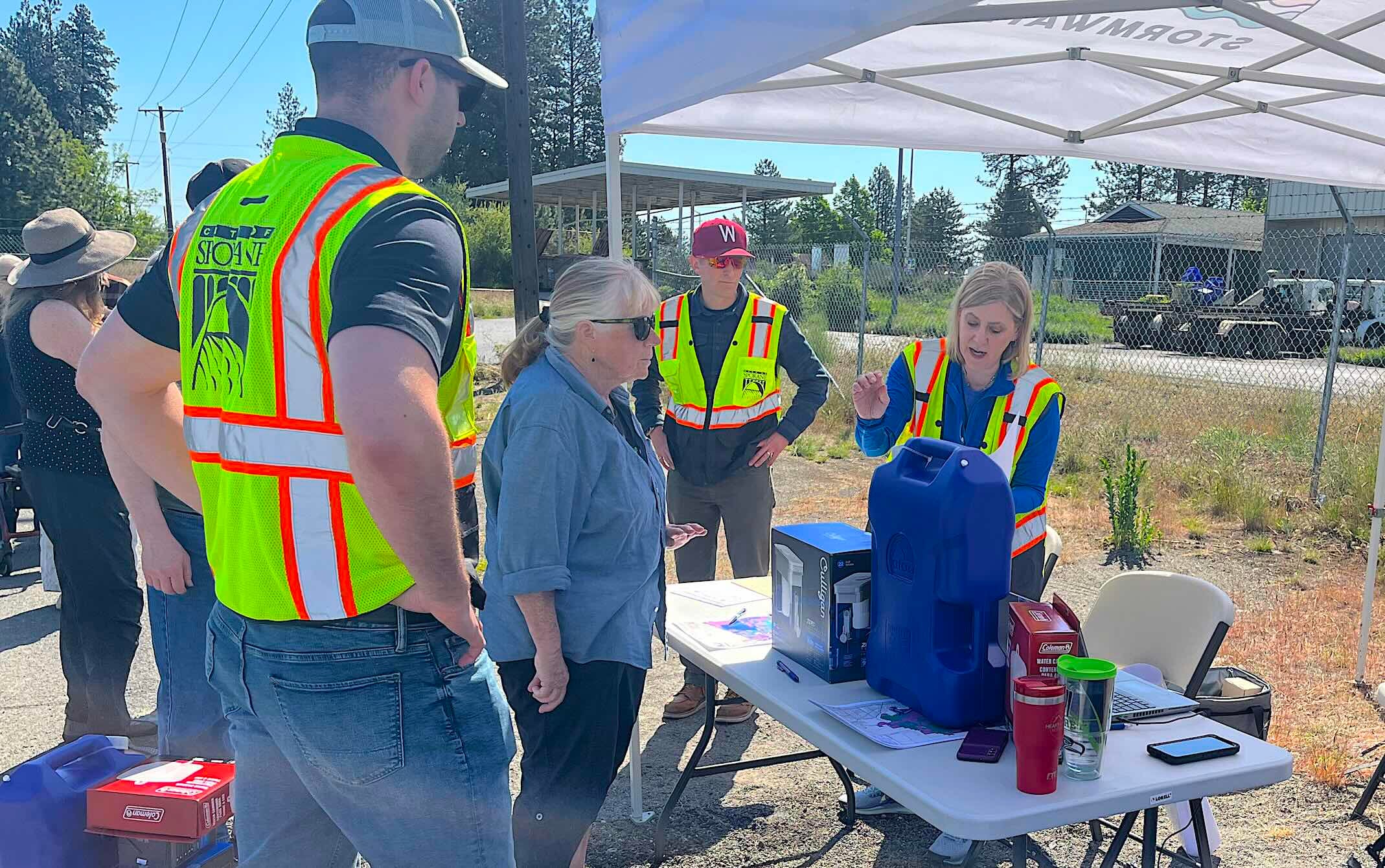
Spokane’s invaluable Public Works director, Marlene Feist, (R) handing out filtered pitchers and clean water containers on the West Plains at Saturday’s distribution event
The West Plains PFAS fiasco won’t be as costly as the billions lost in the WPPSS debacle, but it could plausibly rival the tens of millions swallowed by the RPS fiasco,. But whatever the dollar amount, the ledger can’t easily measure the stress and fear hundreds of West Plains residents have experienced in the past few years. Children can’t undrink water that puts them at higher risk for a variety of diseases, including cancer. The fact that officials in charge of what is supposed to be a public venture—a municipally chartered international airport—kept the contamination under wraps for years cuts deeply. The resistance to accountability continues and it is leaving a civic scar.
That said, this past Saturday brought a long overdue but positive milestone. For the first time in nine years the City of Spokane hosted a public event on the West Plains where people whose well water is tainted with PFAS could pick up filter-equipped pitchers and water storage containers. It was also the first event hosted by any of the three “liable” parties (the city, the county, and the airport) where someone affected by PFAS contamination could actually talk face-to-face with someone representing the city, or the county. (While the County now hosts periodic meetings of a PFAS task force, only the members of the task force are permitted to speak during the task force sessions.)
This weekend’s event was in a weedy, unpaved lot, cordoned off behind the city’s Waste-to-Energy plant just west of the airport. The stark location (amid orange cones and jersey barriers) hadn’t deterred people. Dozens got there well before the published 10 a.m. start time and when they did they were warmly greeted by the city’s host, Public Works director Marlene Feist. Not to put too fine a point on it but Feist has all the qualities you could ask for in a public official. She’s smart, earnest, and seems to have a sixth sense about how to engage people and hear them out. Every city should have a Marlene Feist.
The line for the filtered pitchers and water containers formed at her open air tent awning and then, for those needing additional help, the line led to a shaded table where Liz Goodwin and Sabrina Ryan—recently recruited PFAS “navigators,” (funded by the county and state)—offered guidance tailored to specific needs and circumstances.
Not everybody who came to the lot was happy and at least one—who asked that I not identify him—was deeply upset by the hardships foisted upon him by the PFAS in his well water. As he spoke to me and others he flailed his arms.
Children can’t undrink water that puts them at higher risk for a variety of diseases, including cancer. The fact that officials in charge of what is supposed to be a public venture—a municipally chartered international airport—kept the contamination under wraps for years cuts deeply. The resistance to accountability continues and it is leaving a civic scar.
Saturday’s event was a requirement of a detailed “Short-term Interim Action Work Plan” negotiated between the state Department of Ecology and the three liable parties—the airport, Spokane County and the City of Spokane. As I reported a week ago, the last phase of the negotiations had not gone well. At a jam-packed public meeting in late February Jeremy Schmidt— one of Ecology’s two site managers for the project—acknowledged the difficulties Ecology had been experiencing dealing with the airport/county/city triad. But he sounded optimistic, assuring the large crowd that the parties had made “impressive” progress in the previous two weeks.
But it didn’t last and Schmidt’s frustration (shared by his team at Ecology’s regional office) spilled over as the parties were working to finalize an agreed upon plan in April. It nearly led to the postponement of Saturday’s event. But Ecology decided to proceed with the plan (which Saturday’s event was a part of), but also to register a stiff protest on its website

The tarmac at SIA, looking southwest. Over the past two years the airport’s leadership has spent nearly a half million dollars on legal fees in an often heated conflict with state environmental officials.
Let’s start with the water. A central tenet of the state’s toxic law is that the polluter pays, not the people experiencing the pollution. Beyond the bustling commercial zone of the airport, the West Plains is largely rural, with a myriad of small and large farms, including the cattle ranch that Nick Scharff, a highly-regarded retired fire chief, and his wife Lynn operate well north of the airport. It is in a zone where it is likely the PFAS in their well water is attributable to past training exercises at SIA in which a PFAS variant was the main ingredient in firefighting foam. While they’ve secured a filtration system for their home, the Scharffs still need clean water for gardens and livestock.
In the detailed matrix of the “Short-term Interim Action Work Plan” Ecology was cobbling together with the three “liable” entities, one of them had to take responsibility for making clean water available for those in the large zone that includes the Scharff ranch. According to Feist it only made sense for the city to do so, as it has ample access to clean water from the Spokane valley aquifer and one of its bulk water stations is already located in the Garden Springs area near the airport.
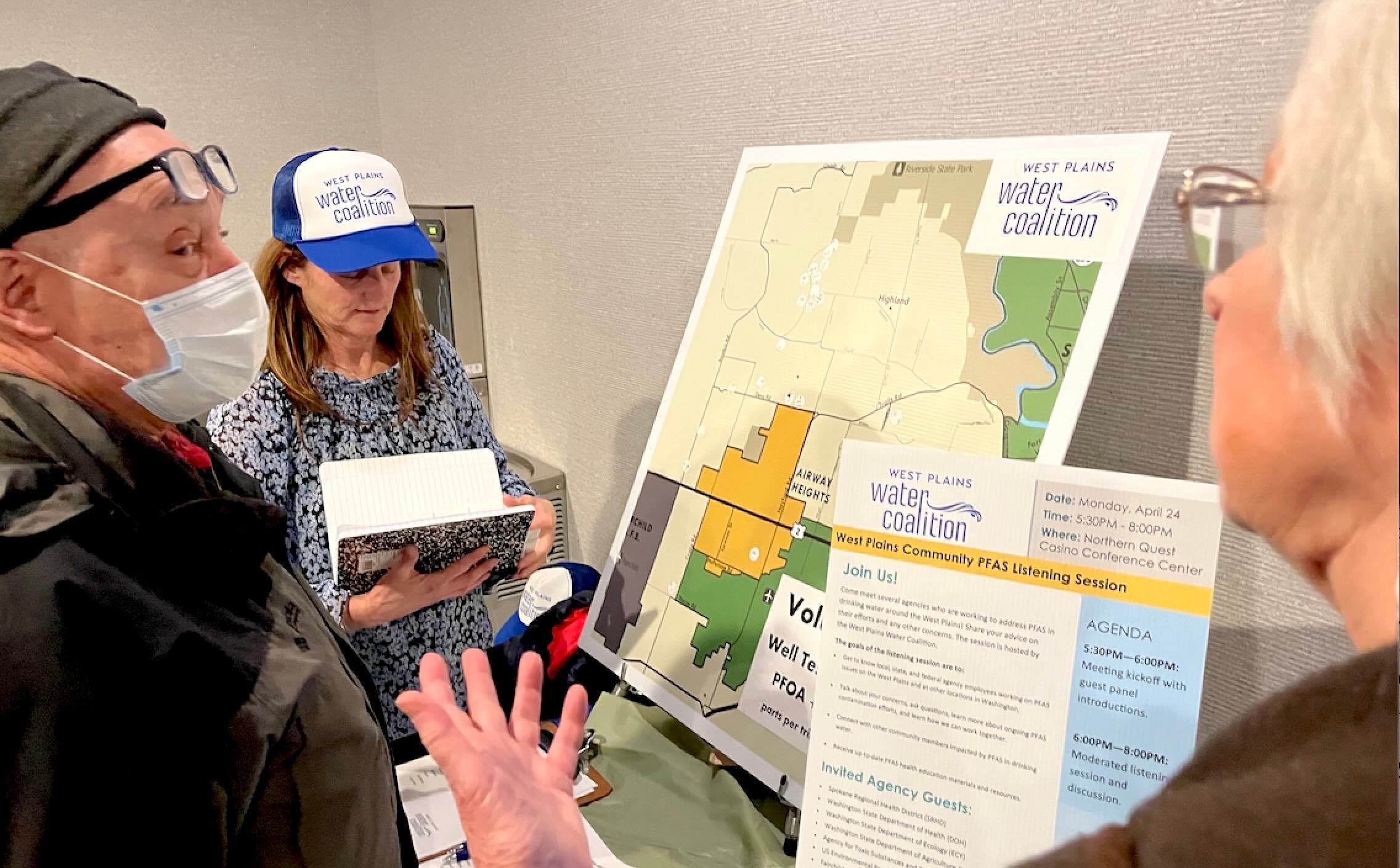
West Plains Water Coalition doing public outreach and education at an event in 2023
The problem arrived when the city reported it would provide the water— but charge for it. It didn’t help that the city made a mistake in its cost calculation that would have set the price of water at 12 cents a gallon. When I spoke to her Saturday, Feist didn’t hesitate to own the error (it has subsequently been recalculated to two-tenths of a cent per gallon) and she expressed regret for the alarm it triggered. She also made clear she is caught between a rock and hard place. While the state’s toxics law requires the polluter to pay, there are also competing state legal requirements that require a charge she isn’t authorized to override.
Today’s post is free, as a public service on an important issue of public health and governance. You can support The Daily Rhubarb and this journalism project with an annual subscription to The Daily Rhubarb at the link above.—tjc
When I spoke to the Scharffs just a few minutes later they were cordial but so upset that they were headed back to the ranch. Lynn joked she had to leave before becoming profane. The problem is they need 5,000 gallons of clean water a week for their cattle, gardening and wildfire protection. Even at .2 cents a gallon, when you add in the cost of retrieving and hauling the water, it’s not a trivial cost of time and fuel. Moreover, it cuts into a guiding principle of state environmental law that people affected by the pollution be made whole.
Nick pointed to another stipulation of the “interim” plan before I even brought it up. In February, Ecology had told a large audience at an indoor event center near the airport that, under the plan’s terms, the city/county/airport troika is obliged to host a public open house. And, as he reminded me, the requirement is in writing, as part of the agreed upon plan.
But don’t bet on it. The Scharffs were already aware of what I was hearing from Ecology and, minutes earlier, from Marlene Feist. Namely, that it would be fine with the city (and the county, and the airport) if the Saturday event in the drive up lot at the city’s garbage and recycling plant could be considered the open house stipulated in the plan. (Ironically, I had been invited by a city elected official to visit with her at Saturday’s event. But the number of city elected officials present for this landmark event? Zero.
On some level the effort to reclassify the filter and water queue at the waste disposal and recycling plant as an open house is darkly funny. But if you’ve been to the public events hosted by Ecology, the state Health Department and the Air Force—where people are allowed to share their experiences and grief not just with officials but with their community—you can see that a formal act of community engagement is illuminating and cathartic even if doesn’t yield immediate results. It looks, sounds, and smells like democracy.
“We’re just checking a box here,” Nick Scharff told me as he and Lynn were leaving. “To me this isn’t an open house.”
Finally, there is the red line issue I tried to unpack in my April 28th dispatch. It is one that may seem complicated but at its core plainly begs the question of whether the city, and the county and the airport are anywhere near committed to participating in good faith.
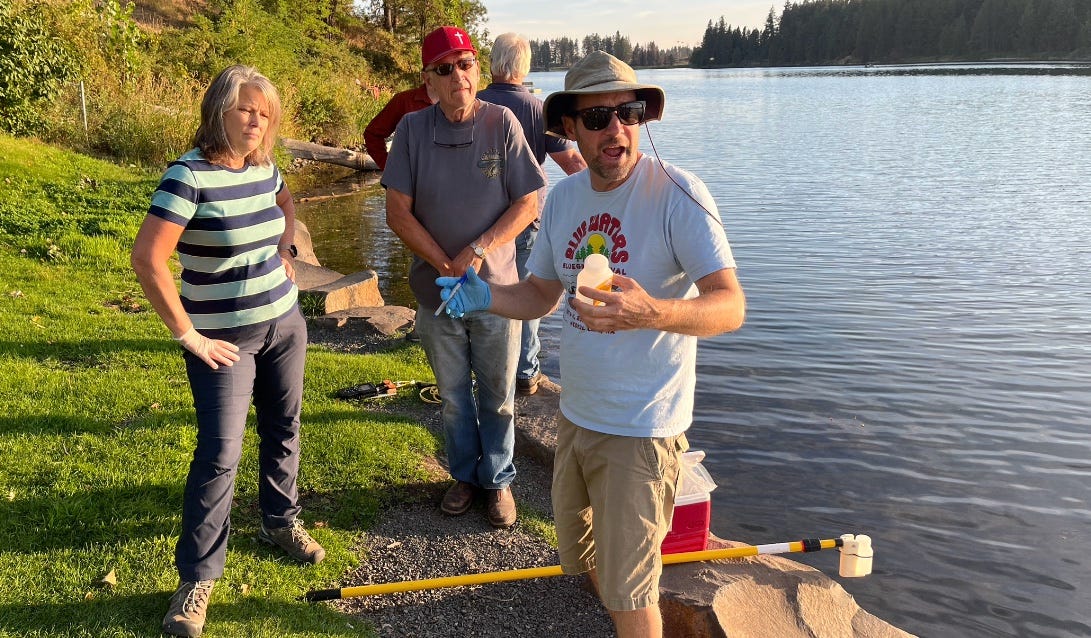
EWU geology professor and Medical Lake city councilman Chad Pritchard working with volunteers collecting water samples to detect and measure PFAS.
As previously noted, for the past three years SIA has fought Ecology’s imposition of the state’s toxics control act at nearly every turn. SIA has spent nearly a half million dollars in legal fees and continues to float the specter of the Federal Aviation Administration (FAA) intervening to bar the airport from funding the PFAS remediation. To date, there is zero evidence FAA is disposed to do so, and that position is clear (at least to most readers) in FAA’s lengthy letter to SIA attorney Brian Werst two years ago.
So you can imagine Ecology’s shock when—in the last throes of negotiating the urgent interim work plan—all three entities (SIA, the county and the city) dredged up the specter that the FAA might yet, still, prohibit SIA from spending any of its money for PFAS cleanup.
The state answered thusly: “Ecology would like to remind SIA that the FAA’s March 29 2024 letter states ‘there is no bar on an airport using its own revenue to discharge its legal liabilities or to settle cases even where liability has yet to be adjudged.’”
But it’s actually even worse than that. In the language the three parties cobbled together is this line: “As joint sponsors of the Airport, The City of Spokane and Spokane County are subject to the same obligations and limitations.”
This debate, such as it is, is rooted in a premise that the covenants attending SIA’s federal grant funds bar SIA from using its own revenues to fund the PFAS remediation. Now the liable parties seemed to be saying that the city and county are also bound by the same FAA restrictions, thus calling into question whether any city or county funds could be spent on the PFAS response. If so then, in theory, Marlene Feist is in big trouble because, when I asked, she told me the pitcher, filter, and containers she was handing out Saturday morning had come out of her Public Works coffers. She noted that the city council approved the expense, so perhaps the council itself is due for a visit from Kash Patel’s FBI. You can read Ecology’s response to this patently absurd legal theory in the table below.
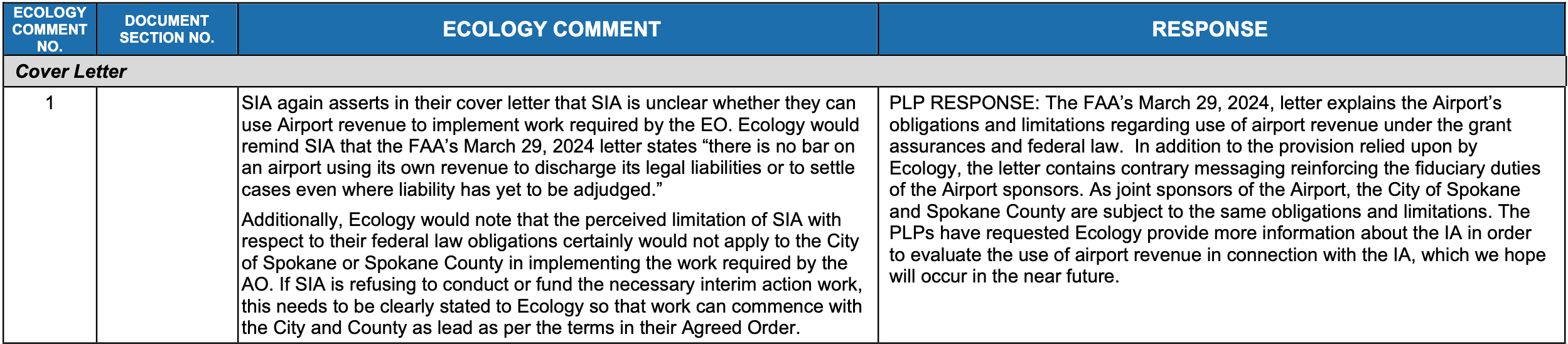
It left me with a simple question, one I’m still pursuing. Did the City’s (and County’s) legal department sign off on this interpretation before conveying it to Ecology?
I had to work my way up the city tree to get an answer, starting with Council president Betsy Wilkerson and the two city council members, Kate Telis and Paul Dillon, who represent (district 2) part of the affected West Plains community. Ms. Wilkerson has long been a member of the SIA board of directors. The only response came via email from Ms. Telis who informed me that Marlene Feist reports directly to Mayor Lisa Brown. She also wrote this: “Since this is pending litigation CMs [council members] cannot comment further.”
But as I noted in my reply, there is no “pending litigation.” To which she responded: “We had an executive session about potential litigation and all conversations conducted in executive session are privileged and not to be disclosed.”
On Wednesday I had a brief off-the-record phone call with Dillon in which I previewed what would have been my on-the-record questions when he had more time to talk. He has not subsequently returned my calls.
I then took my question to City Attorney Mike Piccolo on Thursday. This was his reply: “Mr. Connor, I am unable to respond to your questions without disclosing attorney client communications in violation of the rules of professional conduct. If you wish to make a public records request, you may do so through the public records request portal at Public Records - City of Spokane, Washington.
Piccolo is correct. His advice, if he proffered any, would be shielded by attorney-client privilege. It’s also true, as he states, that even his conversations with his client, the city, are shielded by his duty of confidentiality, which only the client can waive.
I then took my appeal, Friday morning, to Mayor Brown, whom I’ve known for forty years. It’s an appeal for transparency cobbled to a request for her to waive the privilege and disclose what role, if any, city legal had in reviewing the interpretation of the FAA letter served up to Ecology. It’s three pages long. You can read it here.
If the mayor replies, I’ll share it in this space.
—tjc