Independence daze
July 20, 2026

Red, white and blue eyes (2020)
The deep struggle to be an American in 2026
When I was a young football player I would get a lump in my throat listening to my high school band play the Star-Spangled Banner. It was primarily genetic—my dad always flew the flag on the fourth; always carried the memory of his uncles who fought the Nazis. The anthem is wired into my resolute hopes for what our country could be.
But I haven’t celebrated the Fourth of July for several years.
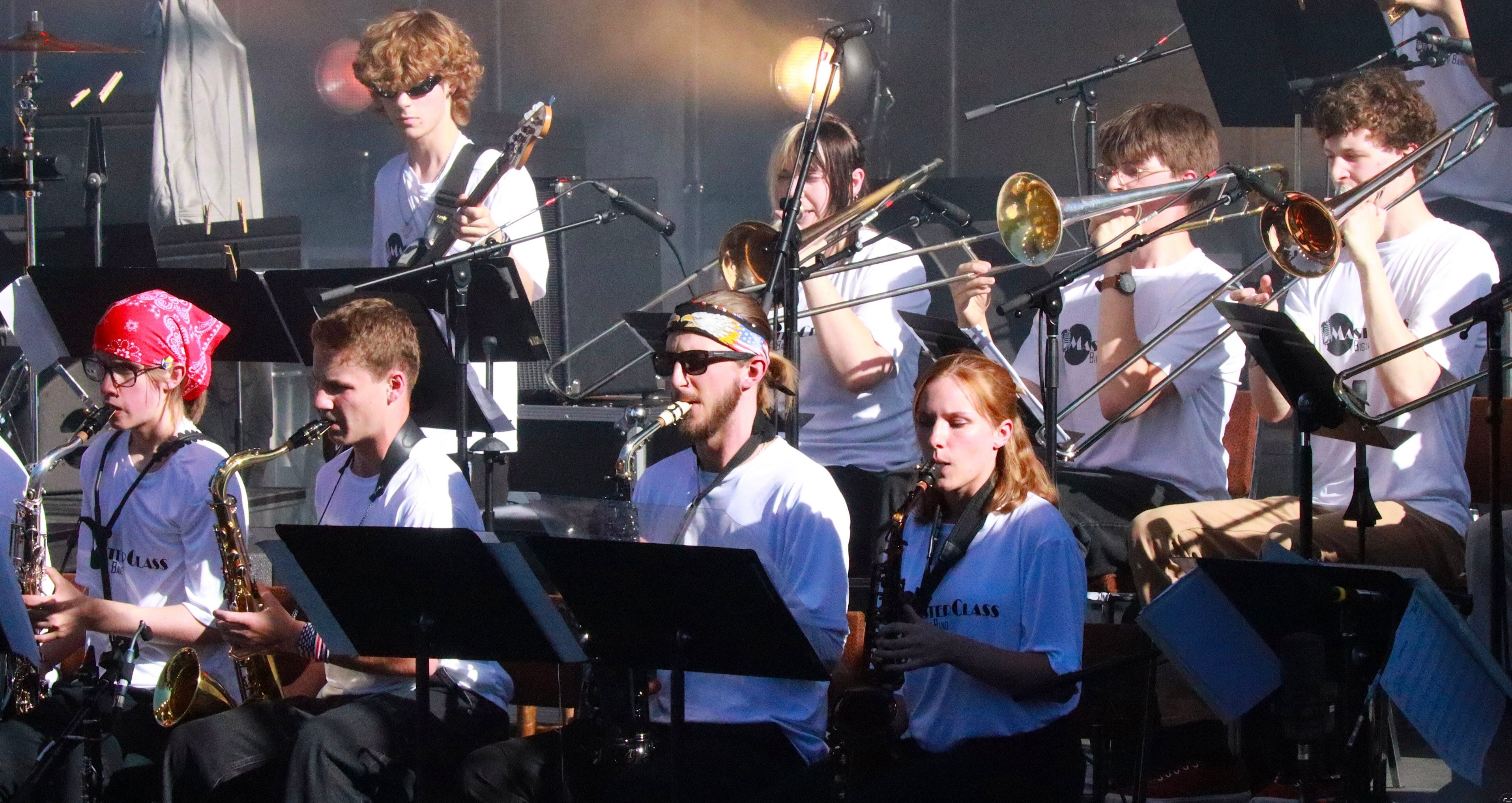
I would have found something else to do this year were it not for the opportunity to walk to Riverfront Park where The MasterClass Big Band (essentially my son’s musical alma mater) was warming up for the Spokane Symphony. It was warm, and I sat on the grass next to Devin’s long-time mentor and saxophone teacher, Chris Moyer. I took a few pictures, and placed a call to my son, who now lives and teaches music in Denver. I wasn’t sure how I’d feel about it. I did have a good time—the MasterClass Big Band is a living music box and a civic jewel— but I didn’t stay for the fireworks. The explosions are loud, and this year, more than others, they carried the emotional shrapnel of tragedy, irony and regret. The music carried the hope.

In a quest for patriotic convalescence, it helped that a few days ago I hope-scrolled to a recently recorded discussion, on the eve of the fourth, between two of my favorite American women—historian Heather Cox-Richardson and, Sarah Longwell, the publisher of The Bulwark. Longwell hails from rural Pennsylvania and has been a devoted Republican most of her life. But no more. The Bulwark is an on-line colony of jaded and well-spoken former Republicans, writers and conservative water carriers—turned “never Trumpers” who’ve found their calling in bravely calling out their former party.
I look around me and I see in a way that I have not seen in my lifetime, my conscious lifetime, American people stepping back up to the plate. And that is how you change the direction of a country. —Heather Cox Richardson
“Disillusionment” is too soft a word to describe Longwell’s sense of betrayal at the turn her former party has taken into Trumpism. But it’s more than that—there is genuine shock and bitterness at the ease with which Trump seduced millions of Republican voters to discard conservative core values and and basic decency. And she’s honest and articulate in how she expresses it.
Longwell has a passion for focus groups—four times a week she rounds up up average citizens and voters to question them about their hope, fears, politics and political preferences.
At the outset of her conversation with Cox-Richardson she played a recording of a recent campaign speech by U.S. Senator John Ossoff who is running for re-election this fall in Georgia.
Here’s what Ossoff said:
“Americans aren’t a race, we’re a people. United not by ethnicity, but by shared convictions, and that is what makes us exceptional and a beacon to the world.
(Chants of USA! USA! from supporters)
Just think, 250 years on, what the founders would see if they visited us today. But wait. They would see that slavery had been abolished. They would see that Americans without land, and then women, and then the descendants of slaves had secured voting rights. They would see that our science and discovery propelled human knowledge to unimaginable heights, and that those thirteen colonies had grown into a superpower that defeated the Nazis and Communism. They’d see a pluralist democracy, people of all colors descended from every point on Earth, stitched together out of many nations into one. But they’d also see a nation that at the height of its wealth and power fell into the very traps they most feared, devouring itself in bitter conflict between warring factions captured by special interests. And they’d see a faithless president exploiting this rot to pursue the absolute power they overthrew.”
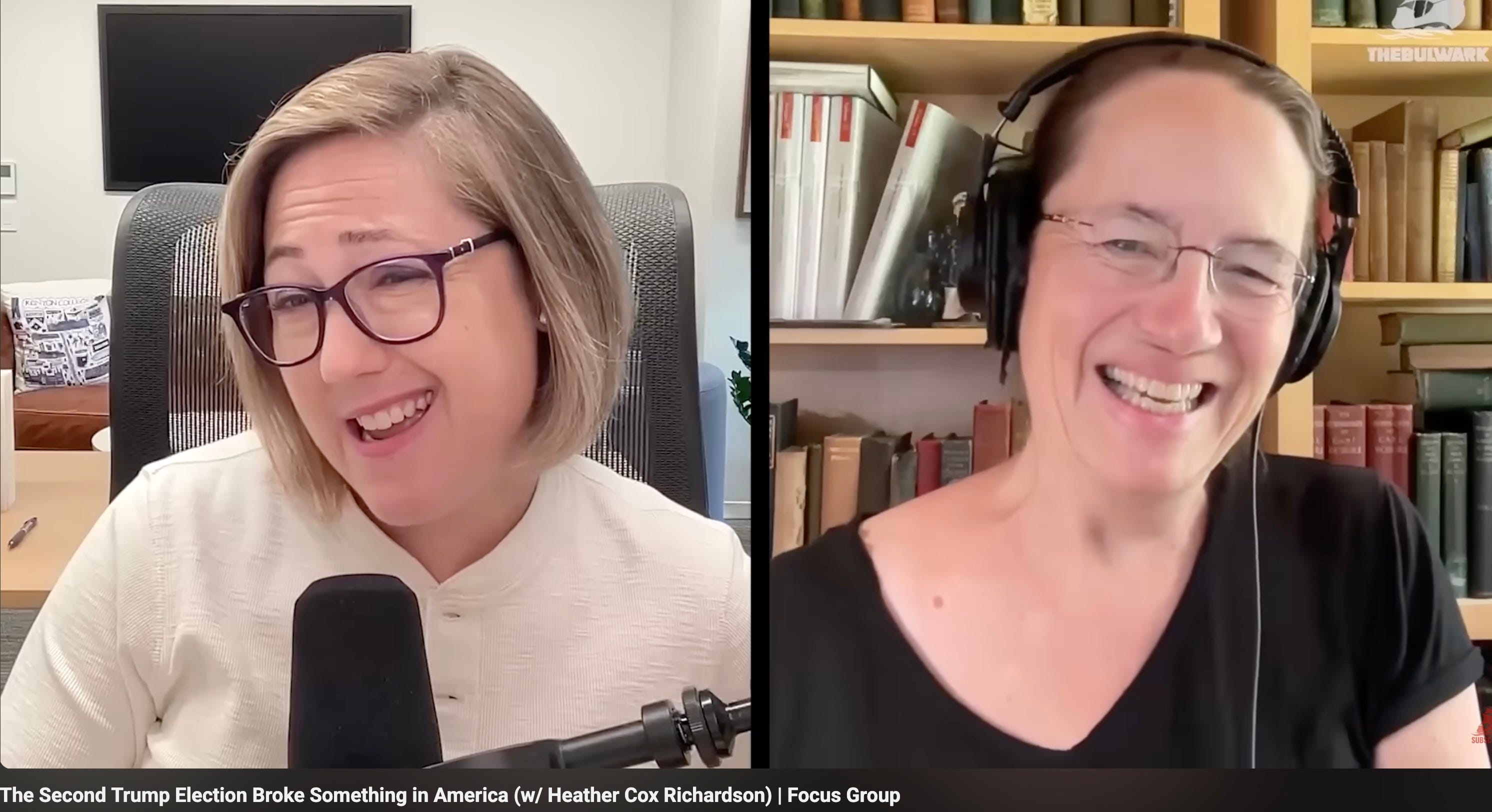
Sarah Longwell, left, and historian Heather Cox-Richardson during their conversation on the eve of the Fourth of July
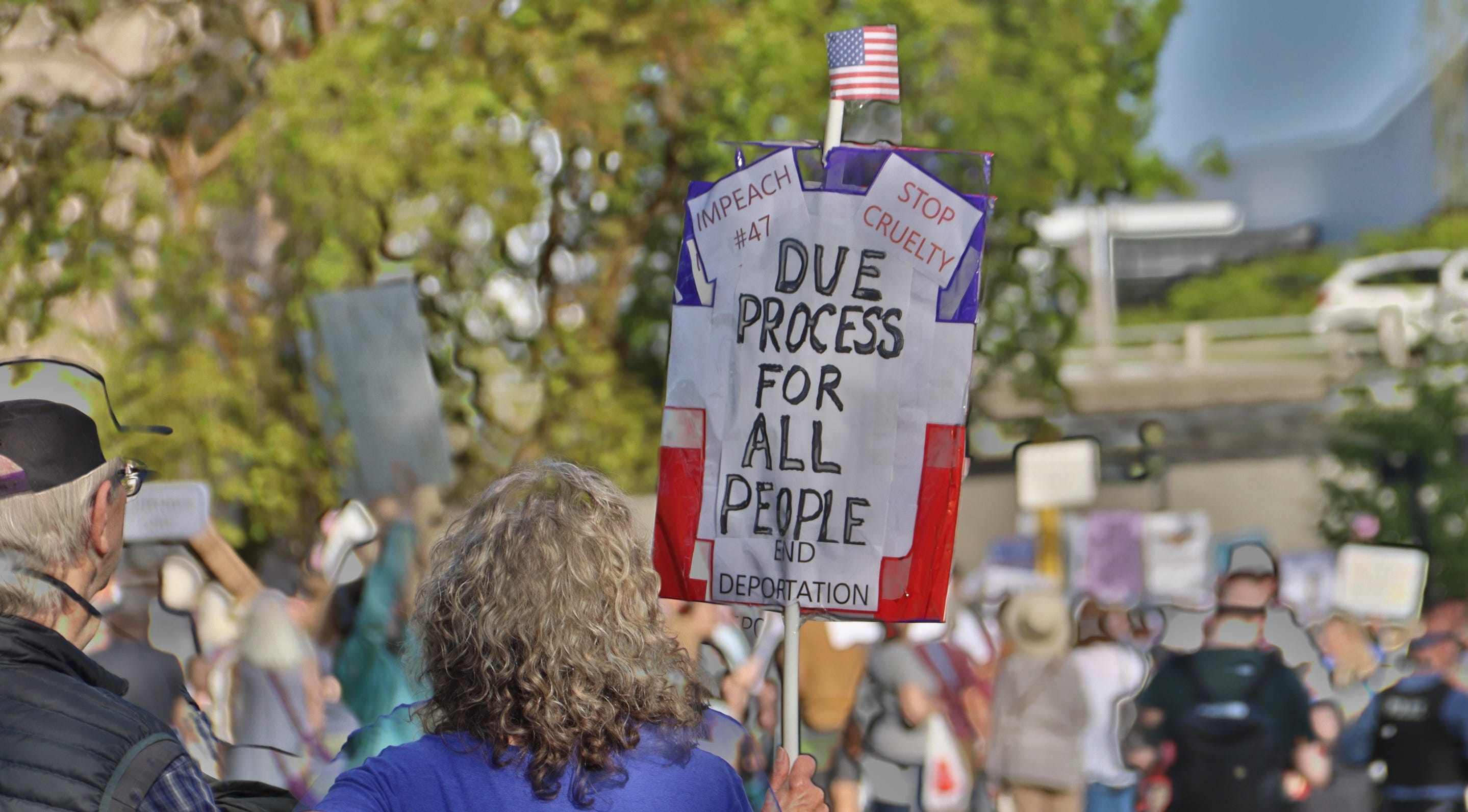
Longwell then played the audio of several Democratic voters, about how they feel about celebrating the Fourth of July this year. Here’s how that went, followed by her and Cox-Richardson’s reactions:
Voice #1: “I was in Canada a few weeks ago and I was like, please don’t let any, like, I don’t want to be identified as an American. Because I just think like, I’m just so shamed of our behavior as a country and like the hatred and just like the, just vitriol towards our neighbors.”
Voice #2: “I think before this last election, I still had a lot of hope that there were a lot of Americans who maybe just didn’t have the privilege to take the time to educate themselves. And now watching the things that Trump is doing and his cronies and the fact that like anyone still supports [him] that has given me like a complete like existential crisis with like who I thought Americans were and what we stood for. I’m embarrassed to go to other countries for trips or to talk to other people from other countries because our country is run by a dictator that all he does is crime.“
Voice #3: “My family’s from Jamaica. That’s everybody’s favorite place to go for vacation, right? But like actually living in Jamaica, seeing what it’s like to actually deal with life as a Jamaican, a lot of people, not just from Jamaica, from the West Indies, from around the world, an American citizenship is gold, and it still is to this day. So from that perspective, I do take that seriously. At the same time, my reason for not being proud to be an American right now, I think, is because it’s not really about the president. It’s more I do think that Americans don’t realize how privileged they are.
Voice #4: I feel like I’ve been ashamed to be an American since I was maybe in college. I backpacked through Europe during the Iraqi war and Afghanistan conflict, and I really got a worldview at that time as like a 22-year-old kind of lesson from people I met from around the world. It really kind of shaped my thinking. It’s horrible what is done to people in this country every day, but it’s been like that pre-Trump. It’s just magnified now. And, you know, it’s like, that’s why I’m always going to vote for change.
Voice #5: Especially like with the 4th of July coming up and the 250th anniversary. It’s going to be a struggle for me, especially because my entire family, my closest friends are all the opposite of me. And so it’s like my husband and I kind of are the outsiders trying to decide what we can and can’t say without causing a battle. It frustrates me like we go to a concert, and all of a sudden the last song is ‘proud to be an American,’ and everybody stands up and, you know, puts their hand on their heart. And my husband and I are looking at each other saying, we just can’t do it in today’s environment—just not feeling it.
Voice #6: A lot of times when I was growing up, it was kind of just like, okay, like, it’s the 4th of July. You have to put on like red, white, and blue, and you have to go to a parade. But now I’m like, I’m not, I’m not putting on red, white, and blue. I just don’t feel, I just don’t feel like I can do it and mean it in any sense.
Sarah Longwell: This is the bummer part of listening to the voters. And I got to say, as somebody who also grew up, I grew up in a small little town like you did, but I was in central Pennsylvania.
Heather Cox Richardson: I know, because I read your book.
Sarah: That’s awesome. But you know what? Somebody did sing ‘Proud to be an American’ at every fair. And there were at the town fireworks that the fire department would put on that you get really bummed out if you couldn’t go because it was raining. And I grew up with a very, like, firm sense of America being good, just based on where I grew up. I grew up around, and granted, it is deep Trump country now. And it had always voted Republican, but now it is, even the numbers of voters have really climbed in the Trump era.
I think one of the reasons I was never attracted to the Democratic Party as a young person is I felt like they didn’t like America as much as I did, or as much as I wanted people to like America. I was always like, ‘look at how great America is.’ And I still feel that way, except I totally am with these guys that I have been in no mood to celebrate America’s 250. None. I’m the audience for the 250, and I cannot feel what I want to feel about the country right now. And I guess, what do you think the difference is between sort of patriotism and like being proud of the country? Like, are those different things? Are those the same things? Because I would still say I’m pretty patriotic while not feeling particularly proud of the country at the moment. And I’ll just say this last thing, which is, I think America electing Trump a second time did real psychological damage to people who thought, maybe even a little bit, I knew we could, this could happen. But I really hoped there was enough in there to keep this from happening again. And the fact that Trump was elected a second time after trying to overturn an election, I do think it’s cratered people’s sense of who we are, at least at the moment.
To support this endeavor, please become a paid subscriber to The Daily Rhubarb at the link above..tjc
Heather: I think I’m a little bit further along that spectrum than you are in the sense that, you know, when the Obama Presidential Center opened a week or so ago..I heard somebody saying, you know, ‘how could the same country that elected this man [Obama] elect Donald Trump twice? And my first reaction was, well, the same country didn’t in the sense that when you think of the way that voting has gone in the United States, certainly really since the 1980s. You know, 1988 and the arrival of talk radio, and then 1996 and the arrival of Fox News Channel. We have created a population that is not operating in the real world. And so when I think about this country, I think about that larger problem with the fact that we are no longer based in reality for a significant number of the people who live here.
That’s one of the things that you and I are combating. That’s why we’re here and why we do what we do, at least in part. But in terms of patriotism in this moment, you know, one of the real changes we’ve seen since the 1980s, I think, is that people have ceased to believe that it’s their, that it’s their government. That they have become subjects in a sense, rather than citizens. And the reason that I’m actually quite excited about the 250th this year and feeling quite patriotic about it is because Americans are rediscovering that.
You know, we never had a perfect past and we’ve never had a perfect present. What we have had is moments of time when people put skin in the game and said, I don’t like the laws about voting, so I’m going to change them. Or I don’t like the laws about taxes, so I’m going to change them. Or I don’t like the way we’re dealing with foreign affairs, so I’m going to change that. And I think you’re seeing that again now in a big way. But part of rethinking what it means to be proud to be an American and what patriotism means is refocusing not on the idea that, you know, America’s always great because—here’s a newsflash—America has always, in every single year that it has existed, been great and done great things. And America has always, in every single year it existed, been awful and done horrible things in the sense that, you know, our government reflects people and people are going to people. They’re both good and bad. The trick for us as a country is to make sure we establish the guardrails and the mechanics of a government that is good more than it is bad. And if we remember that and remember that the real heart of America is, like U.S. {Sen. John] Ossoff said, that commitment to a set of principles, then we can work around the bad stuff and work to make a better country. And I look around me and I see in a way that I have not seen in my lifetime, my really conscious lifetime, American people stepping back up to the plate. And that is how you change the direction of a country.
—tjc