Hand us your lying eyes
October 31, 2025

West gate at the Hole in the Wall Ranch in central Wyoming
America’s culture war and the media road to perdition, Part II
A thru-line of corruption connecting Richard Nixon to Donald Trump is the career path of the late Roger Ailes—the creative force behind Fox News. If history were written by epidemiologists, Ailes—who became a media advisor to Nixon in the late 1960s and a favorite of Trump’s in the 1990’s—would be a colored pin on a map, spreading a blinding, contagious disease from one generation to the next. From politics, to media, back to politics.
Unlike Trump, Ailes was eventually brought down by his lechery.
In a 2014 book, The Loudest Voice in the Room, journalist Gabriel Sherman made the case that Ailes’s media savvy made him the most influential Republican of his generation.
Sherman also disclosed Ailes’s sordid reputation for sexual harassment—his habit of pressuring female broadcasters for sexual favors in exchange for advancing their careers. One of them was a former Miss America, Gretchen Carlson, who sued Ailes and Fox News in 2016. Her case inspired more than a dozen other women to share their stories of being sexually pressured by Ailes. Carlson’s lawsuit ultimately resulted in a $20 million settlement from Fox coupled with Ailes’s dismissal from the network he’d built into a politically influential juggernaut.
When Ailes passed away in 2017, Trump praised him as “a truly great man.”
“Some might say he and the fantastic news network he built are directly responsible for me being where I am today,” Trump added. “I agree.”
Ailes was no longer alive but, if anything, his profitable “fantastic news network” would go even further off the rails of journalism ethics—pushing Trump’s and his surrogates charges of a stolen 2020 election even though the network’s fact-checking department—the so-called Fox “Brain Room”—deemed them to be baseless. (Even Trump’s loyal Attorney General, Bill Barr, dismissed the stolen election allegations as “bullshit.”)
Fox’s persisting effort to give currency to allegations that the 2020 presidential election was rigged was not the sort of mistake news operations sometimes make under the pressure of trying to be the first to break a big story. Rather, it was the purposeful stoking of a bogus conspiracy that Trump and Fox’s largely pro-Trump audience wanted the network to push—one conjuring a multi-state cabal of cheating Democratic operatives, two shady voting machine companies, and somehow rooted in the alleged corruptions [https://www.cato.org/blog/voting-machine-conspiracy-theories-harm-us-cybersecurity] of former Venezuelan president Hugo Chavez—who’d been dead for seven years. Fox has already paid $787.5 million to settle a case brought by one of the defamed voting machine companies (Dominion Voting Systems), and a second case (Smartmatic) is still before the courts.
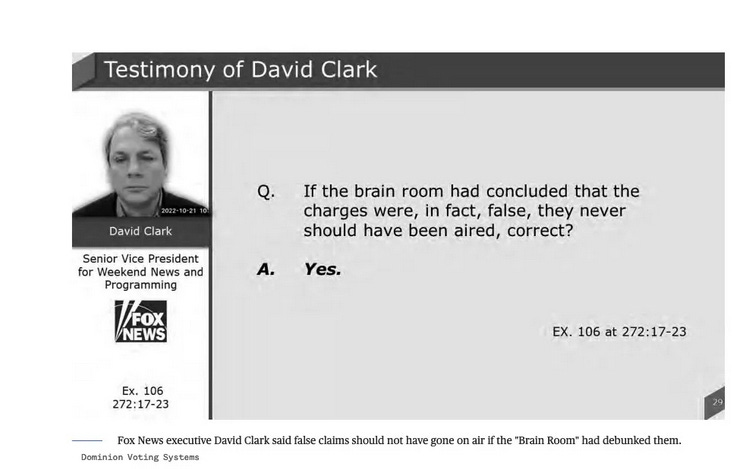
Exhibit from Dominion Voting Systems discovery in the company’s defamation lawsuit against Fox News, quoting a senior Fox executive in reference to the false allegations against Dominion that the network aired.
Pre-trial discovery in the Dominion case surfaced compelling evidence that Fox’s top executives were aware that debunking the voting fraud conspiracies would likely cost them audience share (and thus a loss in advertising revenue) to other right-wing cable channels.
Discovery in the Smartmatic case has implicated Jeanine Pirro—the former host of Fox’s Justice with Judge Jeanine program. Among the damning evidence in the Smartmatic case is a text from Pirro’s own producer at Fox, referring to Pirro as a “reckless maniac.” He also referred to one of Pirro’s shows as being “rife (with) conspiracy theories and bs and is yet another example of why this woman should never be on live television.”
In August of this year Trump appointed “Judge Jeanine” to be the U.S. Attorney for the District of Columbia.
Trumpism, before Trump
Before Roger Ailes, Fox News, and the concurrent explosion of right-wing media, the biggest challenge for American journalism was maintaining an ethical “firewall” between advertisers (who bring in the lions share of revenue) and the newsrooms where the journalists do their work.
Because the First Amendment prohibits laws “abridging the freedom of speech, or of the press,” any culture for journalism ethics has to come from within. Suffice to say, there is no Nuclear Regulatory Commission nor Food and Drug Administration with licensing authority to police for media accuracy, fairness, or publisher conflicts of interest.
Into that space, a century ago, it was journalism’s nascent professional organizations that promoted codes of ethics. Suffice to say, the codes are only as effective as owners and publishers and top editors are willing to enforce them; to put the public interest first, even ahead of investors and advertisers. That can be a big ask, especially when serving the public interest puts journalism on a collision course with powerful politicians and, increasingly, with corporate overlords whose mergers and acquisitions can be undermined or greased by those same politicians.
In the U.S. that collision occurred even before Watergate. Richard Nixon had inherited the Vietnam War from Lyndon Johnson. He continued it, and even expanded it by ordering a secret bombing campaign inside neutral Cambodia followed by a ground invasion in April 1970. The invasion fed into a public and political backlash, eventually leading to the Congressional War Powers Act that passed Congress over Nixon’s veto in 1973.
As anti-war protests and political opposition to Nixon’s escalations of the war mounted, Nixon responded with a famous speech in late 1969. Known as the “The Great Silent Majority” speech it was his appeal to a conservative, patriotic base to support the war in order to reach what he termed “America’s peace.” He said he owed the American people the truth about the causes of the war. But he also said he owed them the truth about the damage to American prestige and influence around the world if he withdrew the U.S. military.
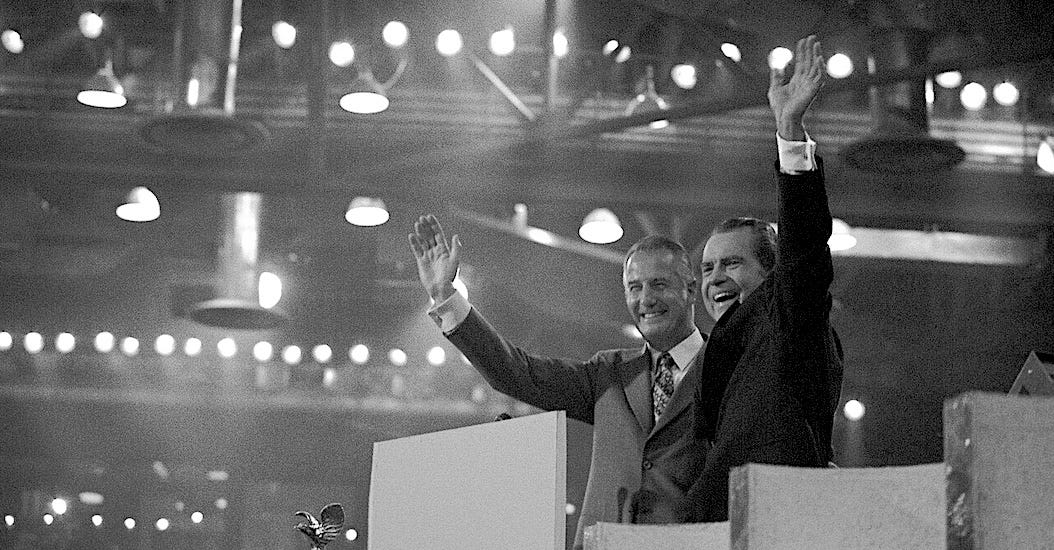
Spiro Agnew and Richard Nixon at the Republican National convention in Miami, Florida in August of 1972, two months after the arrests of Nixon operatives at the Watergate office complex in Washington, DC. (Photo courtesy Wikimedia Images)
The speech went over well enough with Nixon’s conservative base, but his pledge of honesty about the war was a bit much not just for anti-war demonstrators but for correspondents who’d covered the war and borne witness to a growing quagmire, including the purposeful burning of Vietnamese villages and the infamous My Lai massacre.
Ten days later, Nixon’s vice president, Spiro Agnew, was dispatched to give a nationally televised speech from a Republican gathering in Iowa. Formally entitled Agnew’s “The Responsibilities of Television” speech it lives in history books as Agnew’s “Nattering Naybobs of Negativism” speech—a bitter attack on what he described as a “tiny and closed fraternity of privileged men…with profound influence over public opinion.”
The speech was carried by all three of the major networks.
“In many respects, Agnew was Donald Trump before Donald Trump,” wrote Thomas Alan Schwartz in a 2019 article marking the 50th anniversary of Agnew’s jaw-dropping rant in defense of Nixon. “He was a polarizing political figure, beloved by conservatives, hated and mocked by liberals..”
Like Trump, Agnew was also a crook, back when being a crook was a career-ending asterisk on a politician’s resumé.
The ominous warning light from Nixon’s “Great Silent Majority” speech and Agnew’s “Nattering Naybobs” screed is that both were effective in solidifying Nixon’s populist base. They portrayed their critics as subversives, unpatriotic and out of touch with the values and sensibilities of ordinary Americans. Given the choice, the response from Nixon’s loyal, populist base was to blame the journalists.
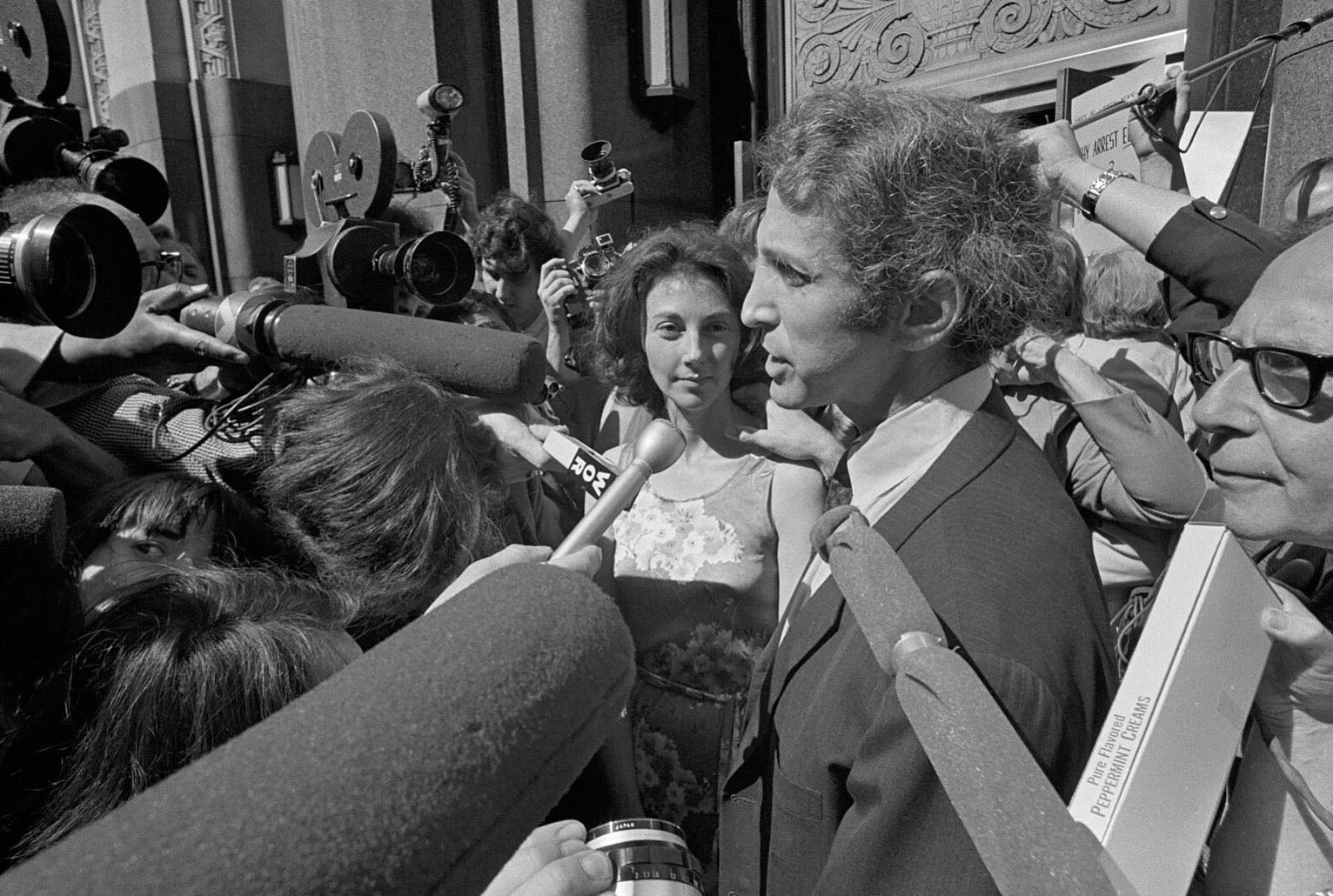
Daniel Ellsberg with his wife Patricia addressing reporters outside the Boston Federal Building in June 1971 (Photo courtesy Wikimedia Images)
Nixon’s account of “the truth” about Vietnam was demolished a year and a half later with the publication of the “Pentagon Papers,” the secret 7,000 page chronicle of American involvement in the bloody conflict dating back to 1945.
The leaker was Daniel Ellsberg, a former company commander in the Marines who, as an assistant to Defense Secretary Robert McNamara, had access to the report. The secret history not only confirmed his misgivings about the war but fueled his resolve to share large portions of it with the American public. He did so by leaking key passages of it to the press, beginning with the New York Times which started publishing the excerpts in June 1971.
Ellsberg’s courage inflamed Nixon’s wrath. Not only did Nixon pursue charges against him for violating the Espionage Act, his contempt for Ellsberg and thirst for revenge led to the formation of a clandestine unit, known as “the plumbers,” that burglarized the California office of Ellsberg’s psychiatrist in September 1971. Nine months later five members of “the plumbers” were arrested during a break-in at the Democratic National Committee’s headquarters in the Watergate office complex, igniting a scandal that would ultimately force Nixon’s resignation in August of 1974. It was the Washington Post reporting team of Woodward & Bernstein that exposed “the plumbers” and their connection to Nixon.
* (The charges against Ellsberg were dropped in 1973 by a federal judge citing “improper government conduct.
“Our own reality”
Attacking the messenger(s) is the first resort of scoundrels, as natural as the flu. But while journalist Ron Suskind was working on a lengthy piece for the New York Times Sunday Magazine in 2004 he encountered what, in retrospect, was an ominous premonition. Deep in his story he recounted a meeting with one of Bush’s senior advisors who chided him when Suskind made mention of the tradition of empiricism that blossomed during the Enlightenment.
“The aide said that guys like me were ‘in what we call the reality-based community,’ which he defined as people who ‘believe that solutions emerge from your judicious study of discernible reality.’”
Susskind wrote that he “murmured” something about principles only to be brusquely cut off.
“That’s not the way the world really works anymore,” the Bush aide responded. “We’re an empire now, and when we act, we create our own reality. And while you’re studying that reality—judiciously as you will—we’ll act again, creating other new realities, which you can study too, and that’s how things will sort out. We’re history’s actors…and you, all of you, will be left to just study what we do.”
Fast-forward to 2018 and Trump’s media advisor, Steve Bannon, brazenly admitting to writer Michael Lewis that the real enemy of Trump’s presidency was not his political opposition, the Democrats, but the press. “And the way to deal with them is to flood the zone with shit.”
“When you’re a star, they let you do it. You can do anything.” Donald Trump, from the notorious 2005 Access Hollywood tape
Trump’s whims, vices, obsession with dominance and preternatural absence of conscience can thwart even the best efforts to comprehend his appeal to voters, a core segment of whom think of themselves as the most morally qualified to decide how we should govern ourselves.
Who would have thought, for instance, that a wealthy, New York City real estate developer caught on videotape bragging about the habitual ease with which he grabs women by their genitals would become the favorite of literally millions of fundamentalist Christians? One plausible answer is that Trump’s dominance of the Republican Party says as much about his most loyal boosters as it does about him—that his giving voice to grievances wrapped in thinly-veiled racism and other prejudices is actually cathartic for millions of voters.
As an institution—albeit an imperfect one—journalism is a cultural anti-dote to racism, militarism, sexism and conspicuous injustice. I’d be the first to concede American journalism struggles with a business model that is inherently corrosive to the high ethical standards readers and viewers (and reporters) have a right to expect. That said the profession of journalism is innately progressive. It embraces empiricism and aspires to build and strengthen community among its readers, listeners and viewers. It does this by searching out and providing accurate information about issues, problems and events that affect the commonwealth.
Today’s installment is free to all readers, but please consider supporting this project with an annual subscription to The Daily Rhubarb at link above, tx, tc
This is precisely why Bannon told Michael Lewis that journalism was a bigger threat to Trump and Trumpism than his political opposition. Trumpism is inherently deceptive; it incites racism, creates scapegoats, puts corporate profits ahead of public welfare and aggressively undermines the rule of law. At a minimum, Trump expects journalists to turn a blind eye to all this.
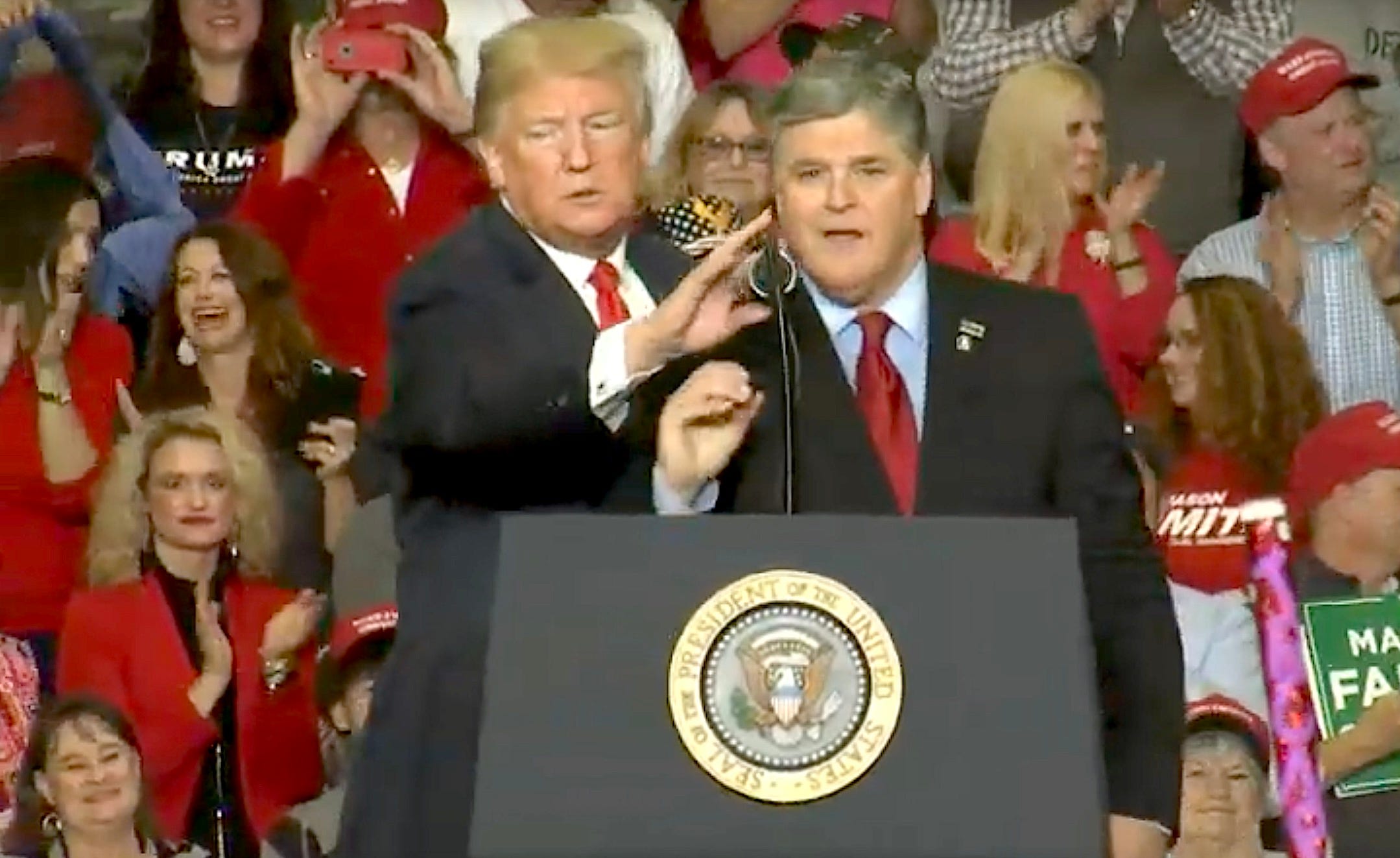
Trump introducing Fox News’s, Sean Hannity at a 2018 MAGA rally in Missouri. (Image via YouTube screenshot)
Trump first branded the “FAKE NEWS media” as “the enemy of the American people” on Twitter in February of 2017. He added the word “SICK” at the end of the message, then deleted it, only to re-post it a few minutes later—deleting “SICK” but adding two television networks to his list of enemy broadcasters. A few days later, addressing a raucous crowd at the annual Conservative Political Action Committee event, he doubled down on the charge: “I want you all to know that we are fighting the fake news. It’s fake—phony, fake. A few days ago I called the fake news ‘the enemy of the people’—and they are. They are the enemy of the people.”
It should surprise no one that Fox News (and its brethren right-wing broadcasters) were not on the media enemy list that Trump distributed in 2017. The simple reason is team Trump and team Fox are of the same cloth, to the point that Fox’s prime time star Sean Hannity had no reservations about appearing alongside Trump at a MAGA rally in 2018.
“By the way,” Hannity exclaimed after Trump adjusted the microphone for him, “all those people in the back [where the press corp was positioned] are Fake News!”
In the cultural swirl of an upside-down ethos—with a freshly convicted felon serving in what is left of the White House—it does not matter that just the opposite is true. Like an arsonist with a gas can blaming a four-alarm fire on the firefighters, Hannity was simply mimicking Trump’s effective technique of projecting his vice onto others. In any real news organization Hannity’s open endorsements of Trump would result in his immediate termination. But Hannity is still at Fox News where, according to Forbes magazine, his annual salary is $25 million.
In just the first four months of his second term, Trump appointed nearly two dozen former Fox News personnel (most notably his Secretary of Defense—aka “Secretary of War”—Pete Hegseth) as employees or advisors to his administration.
“I’ve heard of state run TV,” quipped comedian Bill Maher about the revolving door between Fox News and the Trump White House. “This is TV run state.”
—tjc