Green with irony
August 13, 2026

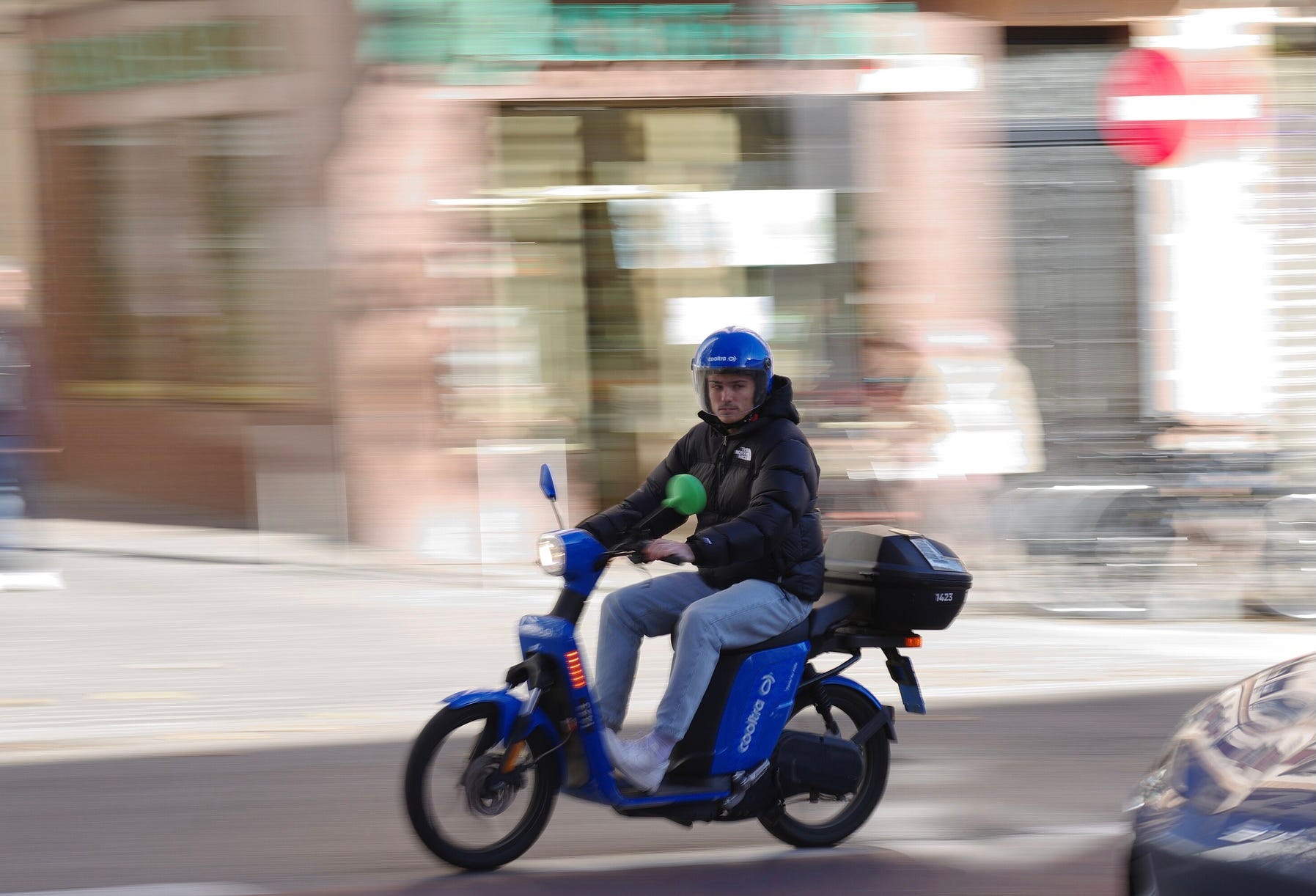
Cooltra electric motorcycle, on the streets of Madrid, December 2025 (photo courtesy Wikimedia Commons)
How the Third World may help save the first
Perhaps I need to get out more.
It was only early last week, walking north in the lingering wildfire smoke on Monroe Street that I finally noticed something. It was an electric motorcycle, with the angular chassis of a real motorcycle. It was going fast, like a real motorcycle goes fast. But instead of an eardrum-battering whine, the only noise was a whoosh.
It only took a moment to realize I was hearing and looking at the future.
The bike itself was not a shock. I ride a regular bike whenever I can. I get passed a lot not just because I’m getting older, but because more and more bike riders on the Centennial Trail zip past me on E-bikes, not to mention the gas-less lime scooters. But this is remains America, where most people can still afford cars—where motorcycles and e-bikes are largely for recreation, and where gasoline or diesel powers well over 90 percent of vehicles on our roads.
I didn’t think that much more about it. There was already too much to think about: Spokane’s devastating fire, the war, the zombie-like submission of Republicans to the corruptions of Trumpism, the gnarly homework for three stories I’ve been working on, and the weekly grind of trying to make ends meet.
Then I happened upon a story that gives me hope and changes the way I think about the world. It was in the New York Times’s “Climate Forward” newsletter, written by globe-trotting correspondent Chico Harlan, from Lahar, Pakistan. The title of the dispatch was “An Electric Motorcycle Revolution”—and it opened with a photograph of him riding shotgun on a new Viktra electric motorcycle.
It was amusing at first, with Harlan finishing an interview with a young Pakistani and then being asked if he’d like to take a spin. Lahar is a city of 14 million people, its streets crossing paths in daunting intersections where hundreds of thousands of new “gasoline-free” vehicles like the Viktra dodge “rickshaws and four-wheelers.” It is not for the faint of heart.
But off Harlan went on the back of the new electric motorcycle. A useful preface to what he was witnessing and reporting on is that Pakistan relies heavily on gasoline delivered through the Strait of Hormuz. Here’s the part of his story that made my brain recoil, not with dread, but with hope.
“(A)ll those motorcycles are emblematic of the big global changes spurred by the war in Iran. By jacking up oil prices, the war has unintentionally accelerated the clean energy transition in developing countries, particularly by influencing the decisions people are making about what kind of vehicle to purchase. In many of the nations most vulnerable to higher gasoline prices, the most common vehicles tend to have two wheels, not four.”
And now many, including Abdul Rafay, the 24-year-old new owner of the Viktra, are buying the two-wheeled bikes powered by electricity instead of gasoline.
“Trump is the biggest salesman. Salesman of the year,” a Pakistani owner of an electric motorbike outlet in Lahar told Harlan.
The joke that circles the planet, of course, is that the U.S. President—who raised millions of dollars in campaign cash from oil companies and denounces renewable energy as the “new green scam”—has stumbled into the tar pit of a war that, on a global scale, bends the cost curve away from petroleum and toward electricity. So not only is the war notoriously misguided, it also mocks Trump’s frat-boy obsession with petroleum. In ways that Trump and his obeisant party didn’t foresee, the momentum toward a greener future has actually continued despite their efforts to reverse it. And it was headed that way even before Iran—in retaliation to the joint Israeli-U.S. attacks—effectively closed the Strait of Hormuz.
As I wrote in this space last October, two of America’s foremost students of energy and the environment—best-selling author Bill McKibben and physicist/designer Amory Lovins—had not just spotted the trend, but were eagerly calling attention to it. The main thrust of the green momentum was coming from China, Africa, Asia and even by creative Americans in the state of Utah. In China it was being driven in part by the need to make air in and around its major cities safer to breath. According to a recent, peer-reviwed health study, the push to replace carbon fuels with solar energy has already extended the lives of a quarter of a million Chinese.
But what McKibben, Lovins and others were seeing in a shift to green energy was happening all over the globe, not just California and Texas (where wind-power has taken off, despite Trump’s mockery of wind power). It is unfolding in Africa and other so-called Third World nations where the proliferation of relatively cheap Chinese-produced solar panels is bringing off-the-grid electricity both to remote villages and densely-populated urban encampments as well.
It could be the biggest story of our time: a movement that may yet spare humanity the worse-case climate scenarios of increasingly common and devastating floods, drought, escalating wildfires and destruction of the world’s coral reefs from CO2—caused acidification of the planet’s oceans.
To continue reading this post and get access to the archives of The Daily Rhubarb, please become a paying subscriber at the link above. tx, tjc