


Facing the day after in a nation on the brink
As of this morning there are less than eighty days to the 2026 national elections. Donald Trump is not on the ballot. But the fate of his presidency—the fate of his dominance of the nation’s governance and discourse—absolutely is. If I can borrow an analogy from Lookout Pass on the Montana-Idaho border, Trumpism is a double hitched, runaway semi-truck. The brakes are shot and there is no runaway Trump ramp.
Consequently, November 4th is likely to be among the most strenuous days in American history.
Why? Simply because the 47th president gives no indication he’ll accept the outcome of an election that is likely to cost him and his Republican enablers bicameral control over Congress. That would mean long-overdue Congressional oversight of his incompetence and corruption, the latter of which will almost surely result in his third impeachment.
Given the powers already vested in him by a Supreme Court stacked with Republican appointees, there is no disincentive for Trump to interfere in the election—to simply resume the insurrection he enabled in January 2021, to try to stop Joe Biden’s inauguration. When he does so, he will do so with the backing of a Republican Party that is bereft of honest brokers (just ask Arizona’s Rusty Bowers) who are unwilling to respect the will of the voters. In the post-cognitive, neural functioning of the runaway party, the only credible election outcome is that the Republican wins, or the election was stolen.
The will to possess power purely for power’s sake precedes Trump’s ascension. The root of it is well-described in work Thomas Mann (the Brookings Institute) and Norman Ornstein (the American Enterprise Institute) collaborated on more than a decade ago, including their book It’s Even Worse Than it Looks.
Here’s how former Nixon White House lawyer John Dean described the book in a 2012 review:
“They [Mann and Ornstein] show how GOP members of Congress have no hesitation whatsoever to put the U.S. Government’s credit rating, if not its very ability to operate, at risk in order to score political points and political advantage. It is a devastating portrait of Republicans in action, and it tells the story of how it all started, with Newt Gingrich’s arrival in the nation’s capital.”
The long march to this power grab included the Republican alliance with the Federalist Society to stack the Supreme Court with jurists (Chief Justice John Roberts, foremost among them) who promote the “unitary executive theory.”
It’s no longer a theory. It’s the operating manual for “Project 2025”— the scheme for converting the federal government into the partisan bulldozer that Ornstein & Mann were warning about 14 years ago. It is the movement the Roberts Court solidified with its 2024 ruling in Trump v. USA — shielding Trump (and future presidents) with broad immunity from criminal prosecution while, in subsequent decisions, allowing Trump to deploy the Justice Department and other agencies (e.g. the Federal Communications Commission) as tools to punish people he perceives as political enemies.
There’s almost too much to absorb on this subject—the ways in which the Trump regime and its Republican enablers in Congress have bought into the Trump mantra that the political opposition is “the enemy from within” and that journalists are “the enemy of the people.”
As former Republican strategist Stuart Stevens has emphasized there is designed racist bent to it—a clear strategy to make it harder for African-Americans to vote and then to challenge the legitimacy of the votes they do cast. The raid earlier this year on the Fulton County election office just outside Atlanta (the one to which the then-Directorate of National Intelligence head Tulsi Gabbert was dispatched to observe) is a clear signal for what lies ahead.
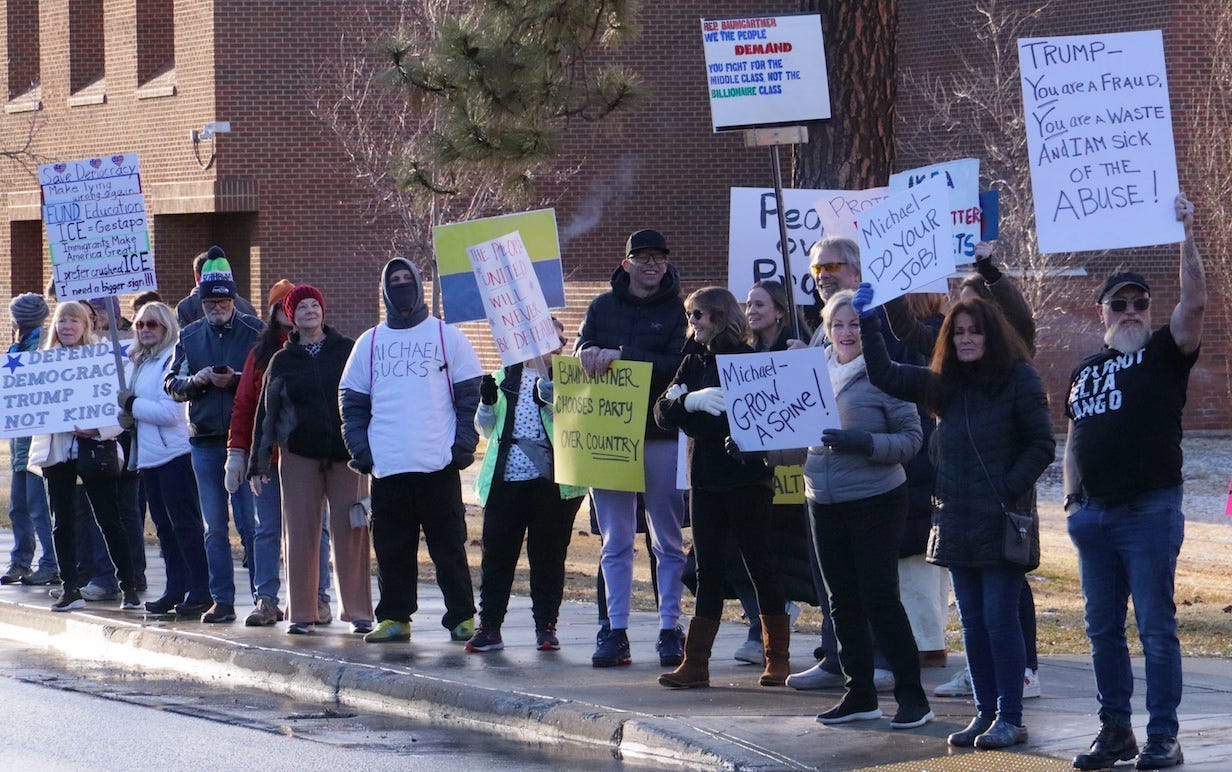
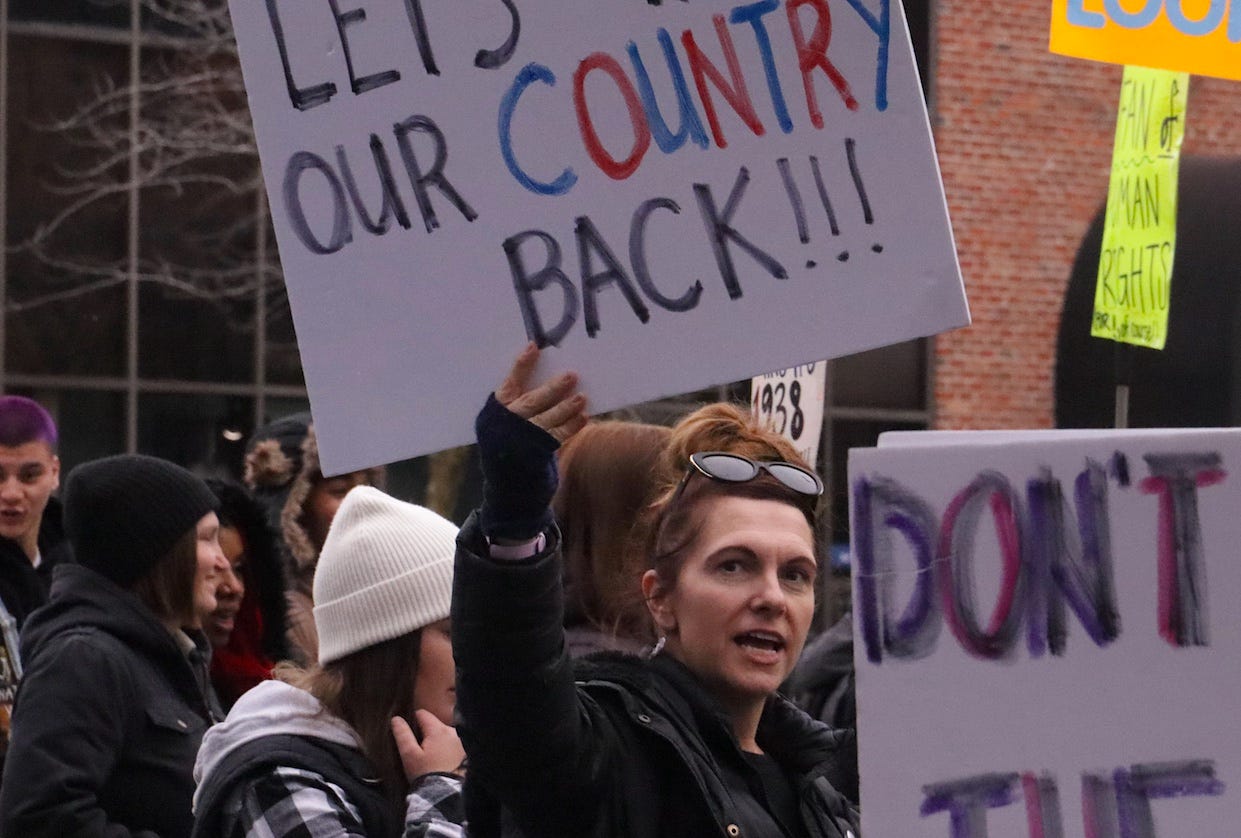
Protestors outside a town hall meeting with Republican Congressman Michael Baumgartner in March of 2025
On Jan. 6, 2021 there was bedlam. But imagine how much worse it would have been had Mike Pence not returned to the well in Capitol after the rioters had been cleared and, against Trump’s wishes, had he not certified the electoral votes.
To be sure, there was then a brief period where Trump’s role in igniting the Jan. 6 insurrection was denounced by the leaders of his party—Minority leader Kevin McCarthy in the House and Majority leader Mitch McConnell in the Senate. That stopped as soon as Republicans realized they needed Trump’s base voters to win future elections, to take control of every branch of the federal government.
This they accomplished.
In doing so they also helped foster the big lie that the 2020 election (and countless others) were stolen from Republicans. The distinguished choir of election deniers includes House Speaker Mike Johnson. Johnson was part of the legal team that worked to stop the certification of the 2020 election. He voted against certification on Jan 6. 2021. He still insists voter fraud by Democrats—to steal elections from Republicans—happens as a matter of course. As for actual evidence—well that’s just too sophisticated to detect.
“Look, some of these efforts are so diabolical and so far upstream it’s impossible to prove,” he told reporters as he was challenging the validity of the Los Angeles mayoral election in June. “But I think everybody knows instinctively that something is wrong here.”
In the post-cognitive, neural functioning of the runaway party, the only credible election outcome is that the Republican wins, or the election was stolen.
Yes, there is something wrong here—namely the willingness to assert, without evidence, that elections are stolen by Democrats.
What Trump, Johnson and Republican loyalists have proven is that once you give yourself permission to demonize your opponents, you give yourself permission to describe them as criminals; people who habitually cheat and rig elections. The surest way to end your career as a Republican is to do what Rusty Bowers did—tell the truth and uphold the law.
It’s hard to accept that this now passes for normal—the tacit acceptance among millions of Trump supporters that the only legitimate election is one that a Republican wins. It is the sort of brainwashing you expect in a totalitarian state, or a motion picture in which something in the food, air or water compels people to behave like zombies or lemmings.
But that is where we are. The toxic clown state of Trumpism, where a flailing, aging leader stays up late posting memes in social media, cratering a wing of the White House to build a gold and marble gilded ballroom, and ordering up prosecutions of people he doesn’t like, regardless of the absence of evidence.
The most poignant words I’ve heard came from a subdued M. Gessen, the exiled, Russian-born writer who bore witness to Putin’s iron-fisted rise. Asked by Ezra Klein how the pace of Trump’s authoritarian rise compares to Putin’s in Russia, Gessen softly replied: “It’s so much faster.”
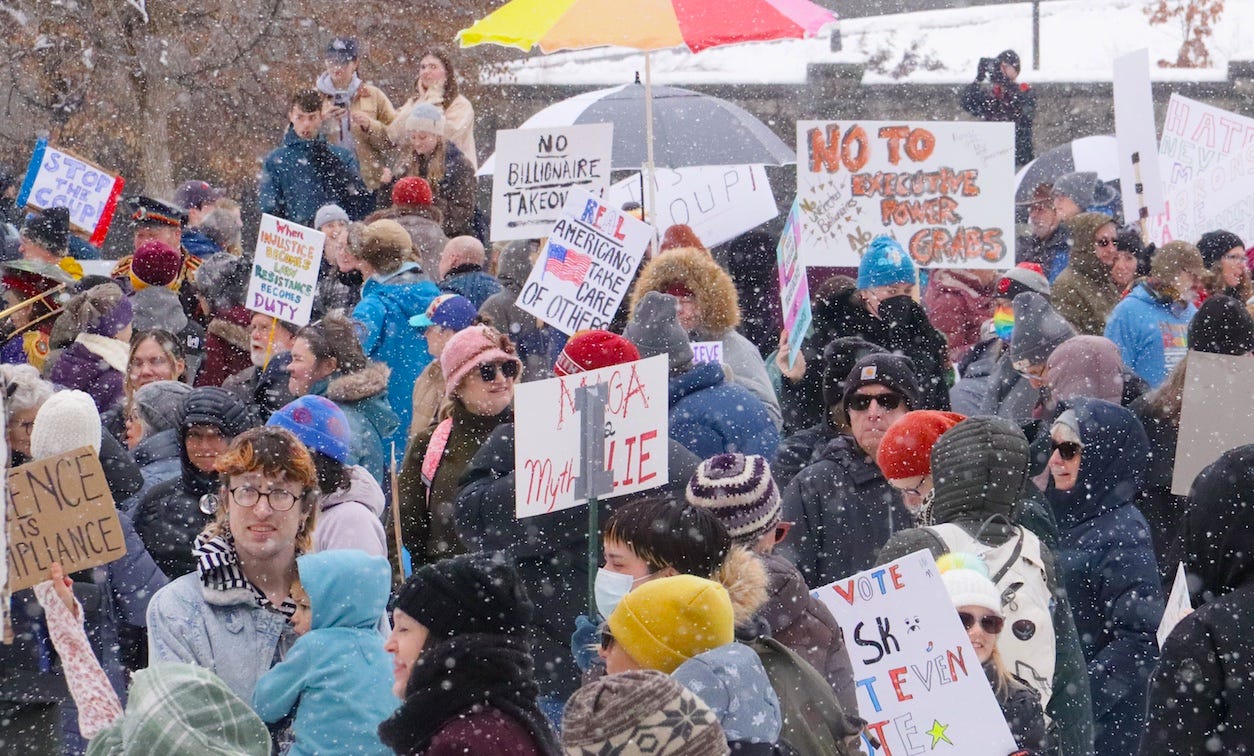
I have more faith in our culture than I do in our politics. A large percentage of Americans don’t participate in politics because they don’t think it has much effect on their lives. My sense is what ultimately affects their lives is when someone in authority demands their fealty and does so with the power to silence their opinions, punish them for their lifestyle, or take away their access to health care or employment. I think that caliber of abusive power offends our culture, our image of ourselves as being free to be who we are. I think that wakes people up, but I don’t think it comes early in the process.
I come from a journalism family on my mother’s side, but whatever that gene is it didn’t get activated until Watergate—when Woodward & Bernstein followed the money to find Nixon’s “plumbers” who clumsily left tape on the lock after they broke into the Democratic National Committee office in the Watergate office complex. I remember CBS News’s iconic White House reporter, Daniel Schorr, reading aloud Nixon’s freshly obtained enemies list and barely breaking stride when he read his own name into the camera.
There’s apparently something in my genes that dialed me in: to fasten my identity and willfulness to be a reporter, to at least be a cog of sorts in an immune system to ward off abuses of power.
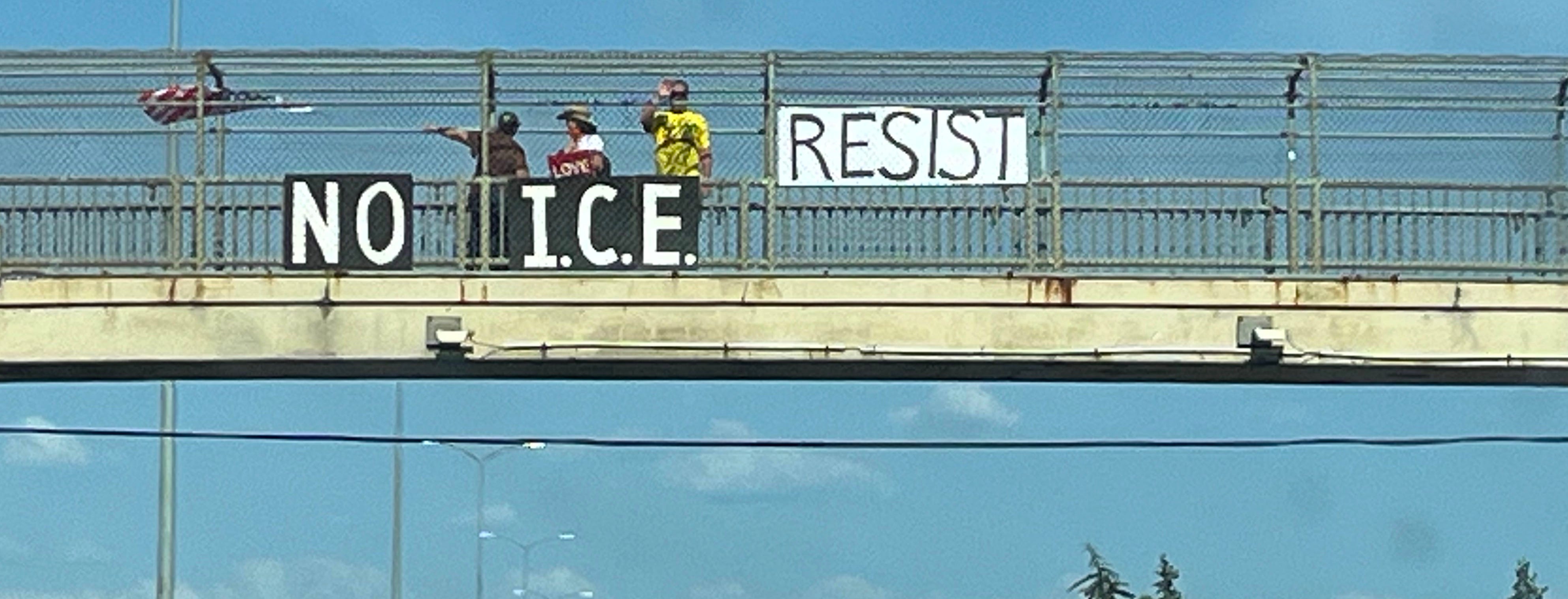
But there are at least two schools of thought about this. There are plenty of good people and good families out there who don’t engage in civic life or politics, nor have any intent of doing so because it could come at the expense of their employment, their careers and the income they need to pay the mortgage and raise their children. The flip side of the freedom of speech is the freedom not to speak. Those choices are sacrosanct. But the most important choice in a democracy is the choice to become involved, to be active in a union, a worthy civic cause, a protest against a war, or an independent journalism project.
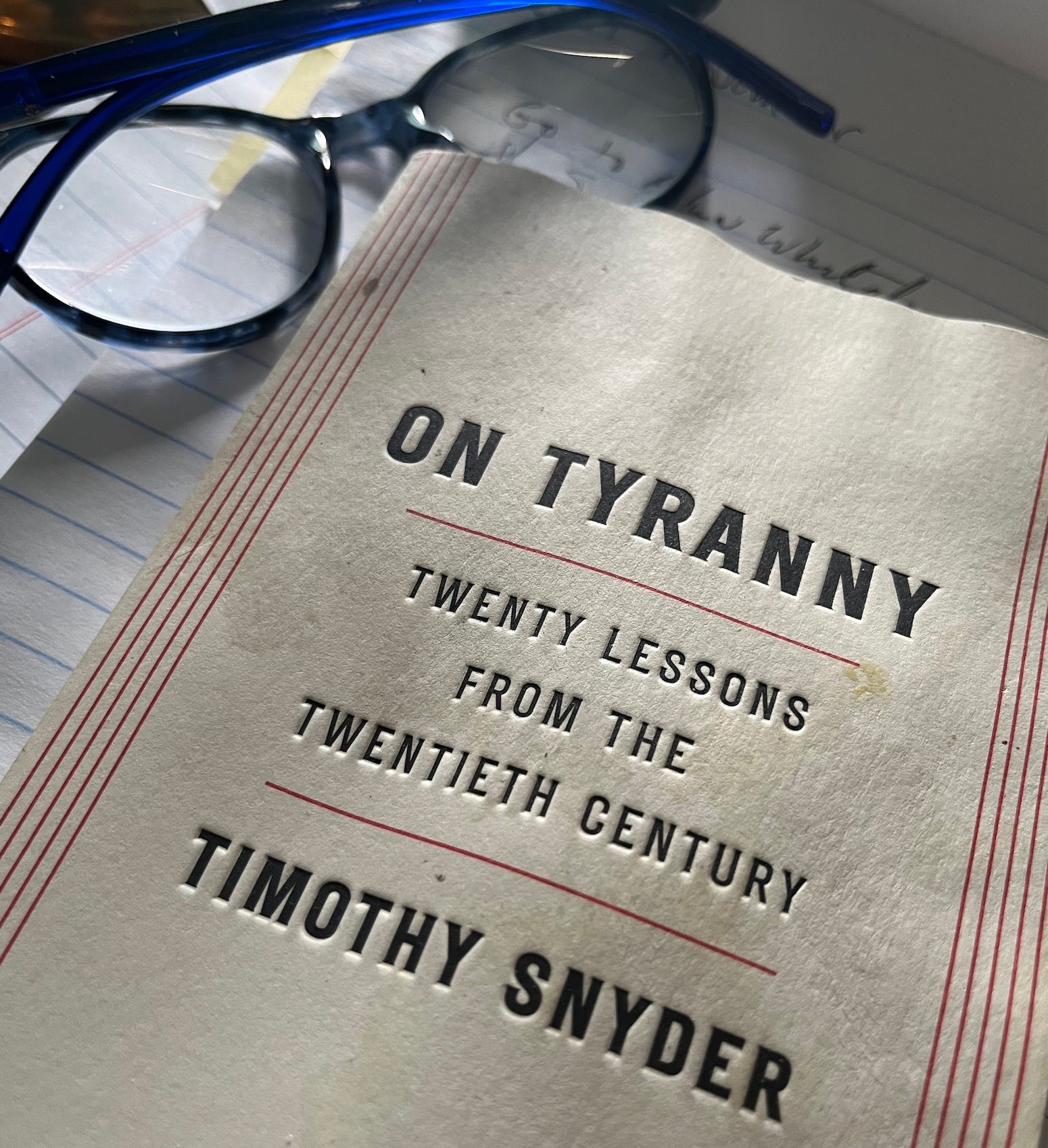
A couple days ago I was listening to the historian Timothy Snyder whose 2017 book On Tyranny has been a manual for resisting the creepy and creeping authoritarianism, racism and cultural bigotry at the core of the Trump movement. He was giving an interview to former Today show host Katie Couric. Early on she asked him to appraise where we are, and what awaits in November.
He began his answer with his assessment that the United States is in the middle of an “authoritarian regime change” on a scale that is “unprecedented” in American history. She followed with a question about whether he thought the American people were aware of the moment, and “what the stakes are.”
Much of Snyder’s answer was startling.
He began by politely noting her question assumed that “people care and that they’re against” the authoritarian government being imposed. He then kicked that tire, so to speak, noting that there is “a fair number of Americans who would be very happy to live under an authoritarian regime”simply because they may benefit from it financially. He also challenged the notion that all Americans love freedom when, in his assessment: “A lot of Americans would like to be told what to do. Maybe a quarter or so. And that’s, you know, that’s Trump’s hardcore. That’s the line below which his support will never go.”
But the other part of his answer had to do with the rest of us, the Americans who aren’t wedded to the Trump medicine show of grievance, retribution, and constant reminders about the importance of 24 carat gold shelf supports and bathroom fixtures.
“(I)f we go along with the kind of normal cliché that Americans love freedom and so on, then we end up convincing ourselves that whatever happens, it must be freedom,” Snyder said. “It’s the same problem with democracy. You know, if we convince ourselves that the U.S. is a democracy, then whatever happens, we kind of convince ourselves that somehow this is within the overall framework of a democracy.”
“(T)here are a lot of people who are indifferent to the political system, so long as they believe they’re going to make lots of money from whatever the transition is. And that’s the problem we have with radical wealth inequality and with oligarchy. We have a lot of people towards the top of our current system who just don’t care.”
You can watch the rest of the interview, below.
To continue reading this post, please become a paid subscriber to The Daily Rhubarb at the link above..tjc